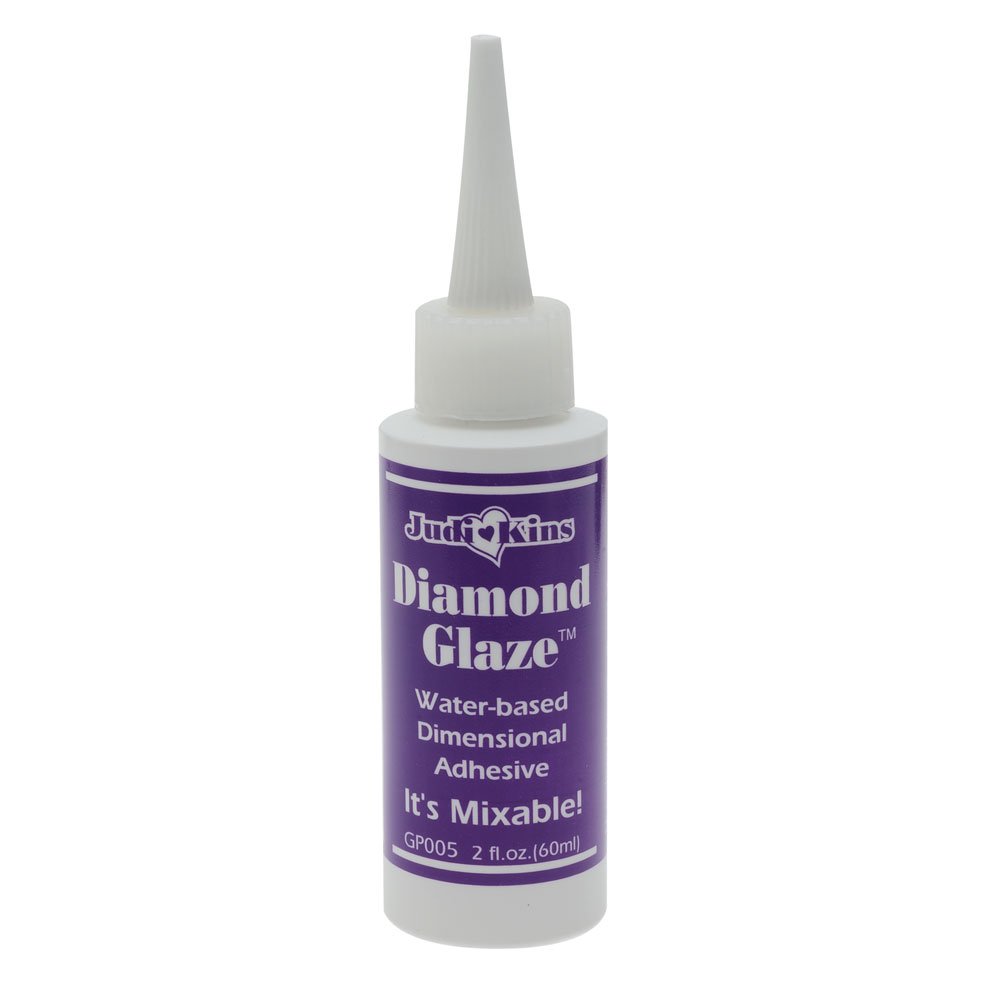
Diamond Glaze from Judikins is one of those craft supplies that tends to circulate by word of mouth rather than through flashy packaging. The 2-ounce bottle contains a water-based, dimensional glaze that dries to a clear, glass-like finish. It has been a staple in card-making, scrapbooking, and mixed-media circles for years, and it occupies a slightly unusual space between an adhesive, a topcoat, and a decorative medium. Understanding what it actually does well—and where it falls short—matters more than the label copy on the bottle.
In practice, Diamond Glaze is most often used to create raised, glossy accents on paper projects. A drop squeezed onto a die-cut shape, a stamped image, or a small embellishment levels out as it dries and leaves a domed, resin-like surface. Crafters also use it to attach lightweight items such as sequins, tiny beads, or paper cutouts, since the wet glaze holds small pieces in place while it cures. It can be applied over printed images to simulate water droplets, glass, or enamel, and it works as a sealant over certain inks and pigments. The 2-ounce size is generous for detail work—this is a product applied in small quantities, so a bottle lasts a long time.
Functionally, the formula is water-based and cleans up with soap and water before it dries, which is a real advantage over solvent-based glazes and resins. It dries clear rather than yellowing in the short term, though long-term aging depends heavily on light exposure and storage conditions. The nozzle tip allows for controlled application, and the liquid self-levels to a degree, which reduces visible brush strokes. Drying time is the main thing to plan around: thin applications may set in under an hour, but thicker domes can take considerably longer and remain tacky in the interim. Patience is part of using it correctly.
There are trade-offs worth knowing before buying. The most common complaint is bubbling—air trapped in the bottle or introduced during application can leave small craters in the cured surface, and once dry, they are permanent. Warming the bottle slightly or applying in thin layers helps, but it does not eliminate the issue entirely. Thick pours can also wrinkle or warp thin paper, since the medium shrinks slightly as it cures. On porous or unsealed surfaces, the glaze may soak in unevenly, so a test patch is wise. And while it adheres to many craft materials, it is not a structural adhesive; anything with weight or stress will need a stronger glue underneath.
Compared with two-part epoxy resins, Diamond Glaze is far easier to handle and requires no mixing, but it cannot match resin’s hardness, depth, or resistance to scratching. Compared with a simple glossy gel medium or varnish, it offers more dimensional build-up and better self-leveling, but a varnish is more economical for covering large flat areas. Compared with dedicated craft glues, it is a weaker bond but a far more attractive finish. In other words, it is a specialist tool rather than an all-purpose one, and buyers should match it to the job.
The product suits card makers, scrapbookers, jewelry crafters working with small cabochons, and mixed-media artists who want controlled, glossy accents on relatively small areas. It is less suitable for anyone hoping to cast or fill deep molds, coat large furniture pieces, or bond heavy objects. Beginners may find the learning curve around bubbles and drying time mildly frustrating, though the water cleanup softens that. Overall, Diamond Glaze is a reliable, well-established medium with clear strengths in detail work and clear limitations everywhere else. Buyers who understand those boundaries will likely find the 2-ounce bottle a practical, long-lasting addition to a craft kit.