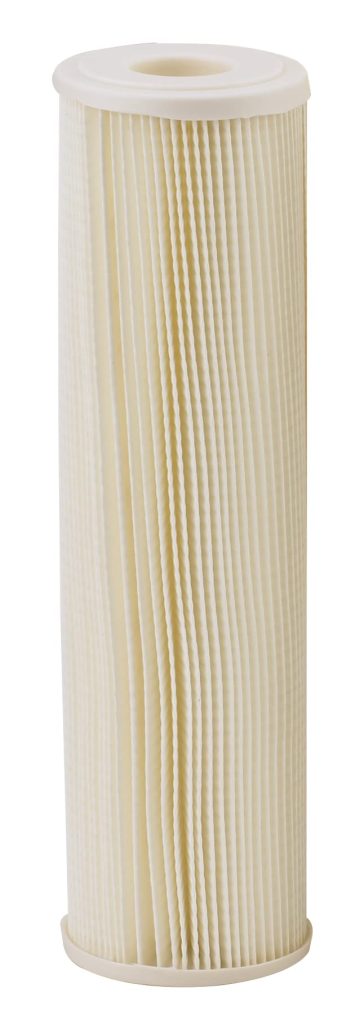
The Pentair Pentek ECP5-10 is a 10-inch sediment filter cartridge designed for under-sink water filtration systems. It uses a pleated cellulose-polyester blend to trap particles down to 5 microns, making it a common choice for households looking to reduce sand, silt, and rust in their drinking water. This review examines its features, real-world performance, and where it fits in the broader water filtration landscape.
Sediment filters are the first line of defense in many water treatment setups. They protect downstream equipment like carbon filters and reverse osmosis membranes from clogging, while also improving water clarity. The ECP5-10 is a replacement cartridge, so it’s not a complete system; it fits standard 10-inch housings with a 2.5-inch diameter. Its white end caps and pleated design are typical for this class of filter.
One of the key functional features is the pleated structure. Unlike string-wound or spun-bonded cartridges, pleating increases the surface area significantly. That means the filter can hold more sediment before pressure drop becomes an issue. The cellulose-polyester media is also designed to resist bacterial growth, though it’s not a bacteria-removing filter. The 5-micron rating is a middle ground: it captures finer particles than a 20-micron filter but doesn’t restrict flow as much as a 1-micron cartridge. The cartridge is rated for temperatures up to 140°F (60°C) and a maximum pressure of 125 psi, which covers most residential water systems.
In real-world use, the ECP5-10 is often installed in under-sink configurations where the water supply feeds a dedicated drinking faucet or a refrigerator. It’s also used as a pre-filter for reverse osmosis systems, where it extends the life of the more expensive RO membrane. Homeowners with well water or older municipal pipes frequently turn to sediment filters like this to address visible particles and occasional discoloration. The cartridge is easy to replace: shut off the water, unscrew the housing, swap the cartridge, and tighten it back up. Most people can do it in under 15 minutes with no special tools.
Performance-wise, the ECP5-10 does what it claims: it reduces sediment. In tests, it effectively captures rust flakes, sand, and silt that would otherwise pass through. However, it’s not a water softener or a chemical filter. It won’t remove chlorine, lead, or dissolved minerals. If you have hard water, you’ll still get scale. If you have chlorine taste, you’ll need a carbon filter. This is purely a mechanical filter for particulate matter.
One limitation is the 5-micron rating. While it’s fine for most sediment, it won’t catch very fine particles like some clays or colloidal matter. For those, a 1-micron absolute filter would be better, but that would also clog faster and reduce flow. There’s a trade-off between filtration fineness and flow rate. The ECP5-10 leans toward maintaining decent flow, which is why it’s popular for whole-house pre-filtration or under-sink use where pressure matters.
Another consideration is the media. The cellulose-polyester blend is not cleanable. Once it’s loaded with sediment, you replace it. Some pleated filters are reusable after rinsing, but this one isn’t designed for that. The manufacturer doesn’t specify a replacement interval, but typical recommendations for sediment filters are every 3 to 6 months, depending on water quality. In heavily sediment-laden water, it could be more often. That’s a recurring cost, though the cartridges are relatively inexpensive.
Compared to alternatives like string-wound cartridges, the pleated design offers higher dirt-holding capacity and more consistent flow. String-wound filters are cheaper but tend to channel and bypass sediment as they load. Spun-bonded filters are similar to string-wound but with a more uniform structure. Pleated filters like the ECP5-10 are generally a step up in performance, which is reflected in the price. However, they are not as fine as carbon block filters, which also address taste and odor. If you need both sediment and chemical reduction, a carbon block is a better single-cartridge solution, but it costs more and may restrict flow more.
Who is this for? It’s suitable for homeowners with a standard 10-inch under-sink housing who need basic sediment reduction. It’s a good fit for well water users or those in older homes with galvanized pipes. It’s also a solid pre-filter for RO systems. It is not suitable for anyone looking to remove chlorine, lead, bacteria, or dissolved solids. It won’t soften water or improve taste on its own. If you have significant water quality issues beyond sediment, you’ll need additional treatment stages.
Installation is straightforward, but you must ensure the housing is compatible. The ECP5-10 fits standard 10-inch slim housings (2.5-inch diameter). Some systems use larger 4.5-inch diameter cartridges, so check before buying. Also, the white end caps are a visual indicator of the 5-micron rating; other ratings in the Pentek line use different colors, which can help with identification.
In summary, the Pentair Pentek ECP5-10 is a competent sediment filter that balances flow and filtration. It’s not a miracle worker, and it won’t solve all water problems, but for its intended purpose—trapping sediment—it performs reliably. The pleated design gives it an edge over basic string-wound filters, though it costs a bit more. If you need a straightforward, effective sediment cartridge and have realistic expectations, this is a reasonable choice. Just remember that it’s one part of a larger water treatment strategy, not a standalone solution.


