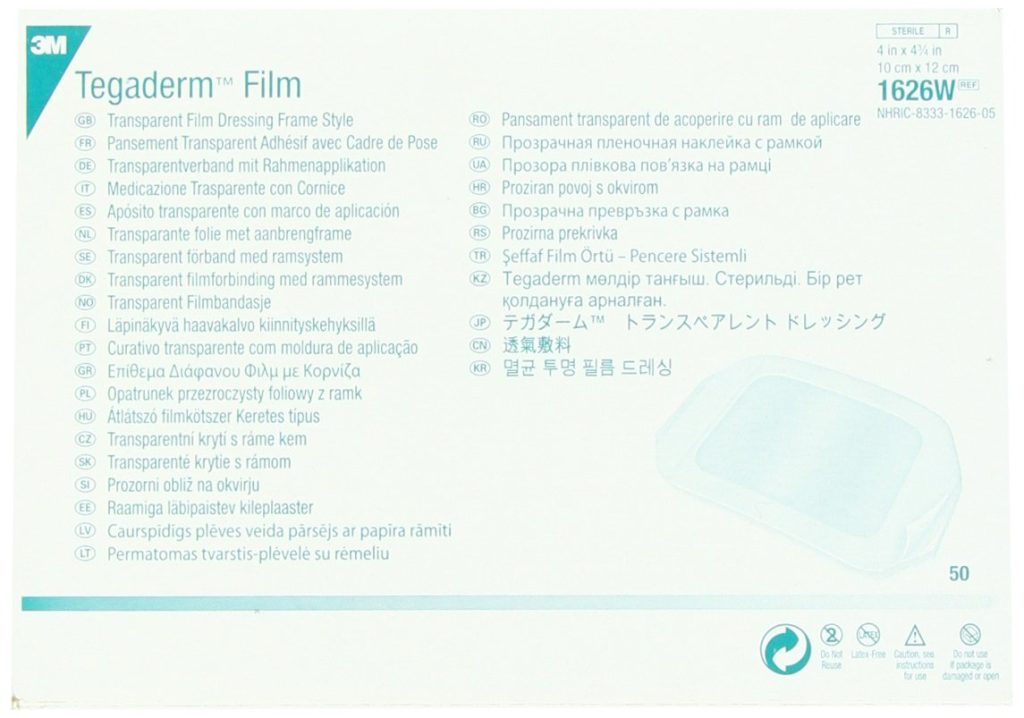
3M’s Tegaderm line is one of those products that shows up so often in clinics, home health kits, and hospital supply rooms that it’s easy to stop noticing it. The 1626W, a 4″ x 4 3/4″ (10 x 12 cm) transparent film dressing sold 50 to a box, is the version most people encounter first. It’s a thin polyurethane film with a hypoallergenic acrylic adhesive, a window-style label for documentation, and a paper frame that helps you apply it without touching the adhesive. It is not a glamorous product, and it isn’t meant to be. The question worth asking is whether it earns its place in a given kit, and the answer depends heavily on what you’re dressing.
In everyday use, this dressing is most often placed over IV sites, central line exit sites, superficial wounds with little to no drainage, and skin tears that have already been closed or covered with a primary layer. The transparency is the functional point: you can look at the site without lifting the dressing, which matters for early detection of redness, swelling, or catheter-related complications. The film is breathable enough to let moisture vapor escape while blocking liquid water and bacteria, so it works as a secondary dressing over gauze or as a stand-alone cover for intact or lightly weeping skin. The included label strip lets a clinician write the date, time, and initials, which is a small thing that makes a real difference during shift handoffs.
Application is where Tegaderm has earned its reputation. The frame delivery system lets you position the film, press down the edges, and peel the frame away in stages rather than wrestling a floppy sheet of plastic. Done correctly, the dressing lies flat with minimal wrinkling. Done hastily, it will wrinkle, and wrinkles are where these dressings fail. The adhesive is aggressive enough to stay put through sweating and light activity but gentle enough that removal is usually tolerable, though anyone with fragile skin should still peel slowly and parallel to the skin rather than pulling up.
The limitations are worth being direct about. First, this is not an absorbent dressing. It handles essentially no exudate. Put it over a draining wound and fluid will pool underneath, the edges will lift, and the seal will fail within a day or two. Second, the film doesn’t stretch much, so on highly contoured areas like the sacrum, elbows, or knees it can tent and peel at the edges. Third, moisture trapped under the film, whether from sweat or from a wound, softens the surrounding skin and can undermine adhesion. Fourth, the 4″ x 4 3/4″ size is a middle-of-the-road option; it’s too large for a small forearm IV on a thin patient and too small for many surgical incisions, so you’ll often need a second size on hand. Finally, cost per dressing is higher than plain gauze and tape, and a box of 50 is a meaningful commitment if you only use a few a month.
Compared with a hydrocolloid dressing, Tegaderm is thinner, more transparent, and better suited to intact skin and catheter sites, but hydrocolloids handle light drainage and provide more cushioning. Compared with a simple gauze-and-tape setup, Tegaderm offers better visibility and a more reliable moisture barrier, at the cost of breathability in heavy sweat and a higher price. Compared with other transparent film brands, the differences come down to adhesive feel and the frame design; 3M’s frame is generally regarded as one of the easier ones to use, but the gap isn’t enormous.
Who is this for? Clinicians and caregivers who need to secure and monitor IVs, cover clean or lightly weeping wounds, or protect skin at risk of friction will find it a dependable workhorse. Home users managing a single catheter site or a small superficial wound will appreciate the visibility and the easy application. Who is it not for? Anyone dressing a wound with moderate to heavy drainage, an infected or heavily colonized wound, or a site on a highly mobile, contoured joint where a more conformable dressing would hold better. People with known adhesive sensitivities should patch-test first.
Realistic expectations matter here. A well-applied Tegaderm on a clean, dry, relatively flat site will typically hold for several days, which is in line with typical dressing change intervals. On a sweaty patient or a contoured area, expect shorter wear and plan accordingly. The box of 50 is convenient for a clinic or a frequent user and less so for occasional home use, where a smaller pack may be the more sensible buy. It’s a solid, well-understood product with clear boundaries, and it performs best when those boundaries are respected.