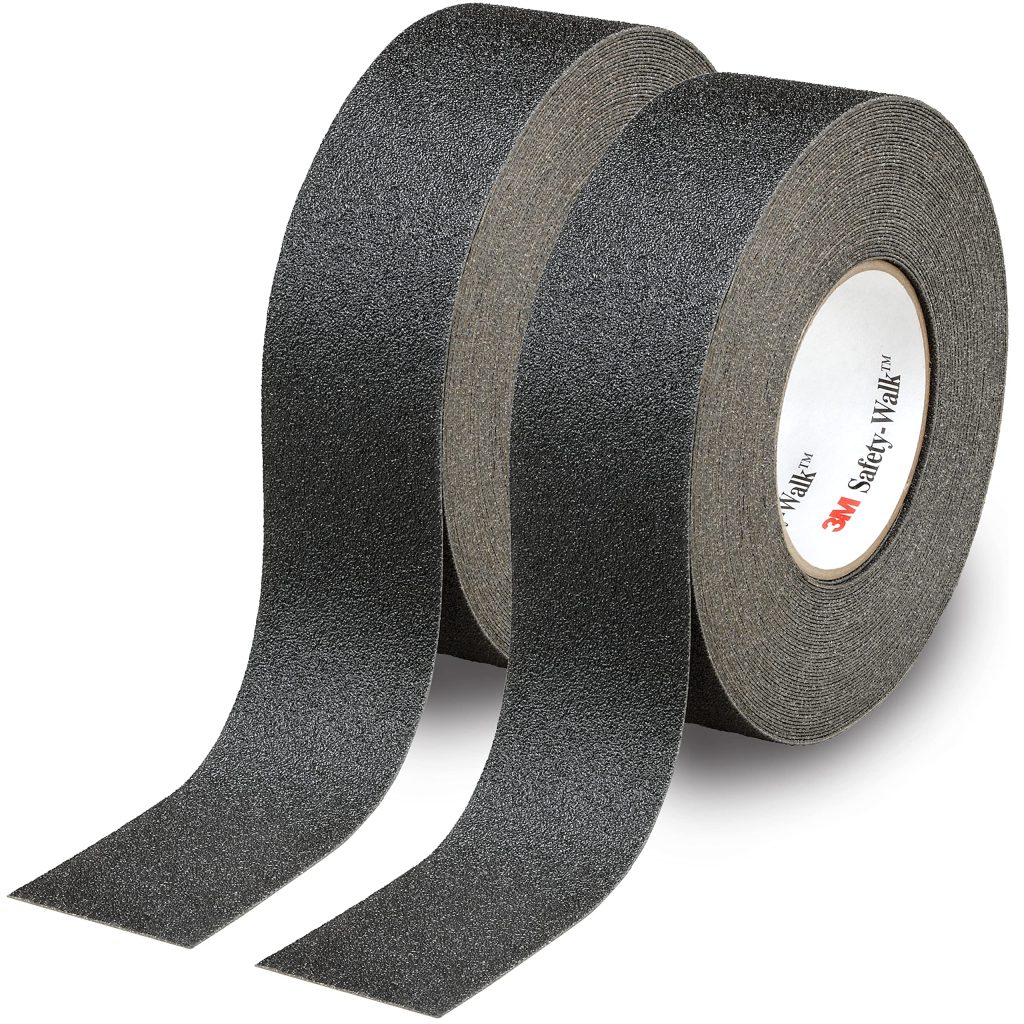
Slip-resistant tape tends to be an afterthought, bought in a hurry after someone takes a tumble on a wet ramp or a smooth garage floor. The 3M Safety-Walk 510 roll sits in a slightly different spot than the stiff, gritty strips sold at most hardware stores. Its defining trait is conformability, which means it can follow curves, contours, and mildly uneven surfaces that rigid treads struggle with. That single characteristic shapes almost everything about how it performs and where it makes sense to use.
The roll measures 2 inches wide by 60 feet long, so it is a bulk format rather than a set of pre-cut strips. That matters in practice. Anyone taping a short stair edge will find far more material than needed, while someone lining a curved walkway, a boat trailer, or the lip of a loading dock will appreciate having continuous length to work with. The backing is a pressure-sensitive adhesive, and the surface is a mineral-abrasive grit bonded to a flexible film rather than the thick, hard plastic used on conventional treads.
In real use, this tape shows up in places where standard anti-slip strips peel up at the edges. Because it bends, it can wrap around pipe covers, follow the radius of a curved step, or lie flat across slightly pitted concrete. Application is straightforward: clean and dry the surface, press the tape down firmly, and give the adhesive time to set. It is not a permanent structural fix, and it will not level out a badly broken floor, but for cosmetic and functional slip reduction on difficult geometry it does what it claims.
Functional characteristics worth knowing:
- Conformable backing allows the tape to follow curves and mild irregularities without creasing, which is the main reason to choose this over rigid treads.
- Mineral abrasive surface provides grip in wet and dry conditions, though the grit is less aggressive than heavy-duty industrial treads.
- Pressure-sensitive adhesive bonds to clean, sound surfaces; adhesion quality depends heavily on surface prep.
- 2-inch width suits stair nosings, thresholds, and narrow strips but is not intended to cover large floor areas.
- 60-foot roll supports long runs or multiple small applications from a single purchase.
The main trade-off is durability relative to surface condition. On smooth, clean concrete or painted metal, the tape holds well. On dusty, oily, or freshly sealed surfaces, adhesion suffers, and edges can lift over time, especially in high-traffic areas or where the tape is exposed to standing water. The abrasive grit also wears down with heavy foot traffic, so a busy commercial entrance will likely need replacement sooner than a residential garage or a seasonal boat application. It is also worth noting that black tape on a light floor is visually obvious; this is a functional product, not a design element.
Compared with pre-cut anti-slip treads, the 510 roll trades convenience for flexibility. Pre-cut treads are quicker to install on standard stairs and often come with a more aggressive grit, but they crack or lift on curved or uneven surfaces. Rubber or PVC stair mats offer more cushioning and are easier to remove, but they are bulkier, cost more per foot, and can shift unless fastened down. For irregular geometry, the conformable tape fills a gap that neither category handles well.
Who is this for? It suits homeowners dealing with a slick garage step, boat owners taping a curved gunwale or trailer, facility staff patching small slip hazards on loading docks, and anyone who needs a continuous strip rather than fixed lengths. It is also reasonable for temporary or seasonal applications where removal is anticipated.
Who is it not for? Anyone expecting a permanent, heavy-duty solution for a busy commercial stairwell should look at bolt-down treads or professionally applied coatings. People with very rough, crumbling, or damp surfaces will likely be disappointed, since the adhesive needs a sound substrate. And if the goal is cushioning or aesthetics, a rubber mat or a colored tread is a better fit.
Realistic expectations matter here. This tape reduces slip risk on the surfaces it is applied to, but it is not a substitute for fixing a fundamentally unsafe floor, and it will not last indefinitely under heavy abrasion. Installed carefully on a clean, appropriate surface, it performs as described and solves a specific problem: gripping where flat, rigid strips cannot.