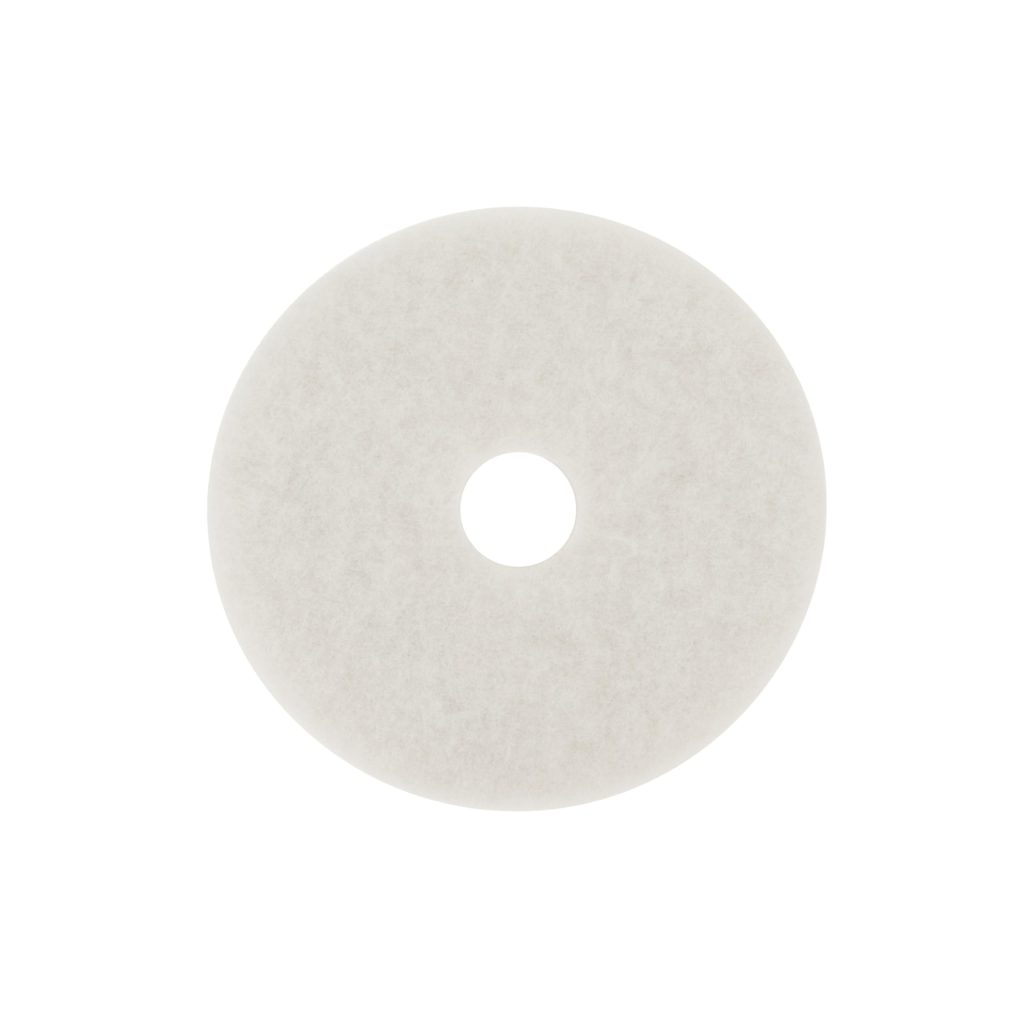
The 3M Super Polish Floor Pad 4100 is one of those maintenance-catalog items that rarely gets discussed outside janitorial circles, yet it shows up in a lot of commercial floor care programs. Sold in cases of five in a 19-inch diameter, these white pads are intended for the final step of a floor care routine: bringing a polished shine to a floor that has already been cleaned, scrubbed, and possibly burnished. They are not a stripping pad and not a general-purpose scrubbing pad, and understanding that distinction goes a long way toward deciding whether they belong in your supply closet.
In practice, the 4100 is used under a standard low-speed floor machine, typically in the 175–350 RPM range, though some operators run them on higher-speed equipment with care. The white, non-woven construction is designed to be mild. That mildness is the point: the pad is meant to remove scuffs, light marks, and dulling film without cutting through the floor finish you paid to apply. In facilities with VCT, terrazzo, or other hard surfaces under a polish coat, this is the pad that goes on after the scrub-and-recoat work is done, or as part of a periodic spray-buff routine.
Functionally, the pads are uniform in thickness and the 19-inch size fits standard 19-inch rotary machines and many auto-scrubbers with pad drivers. The fiber distribution is consistent across the surface, which matters because an uneven pad can cause the machine to wobble or leave swirl patterns. The white color is also a practical signal in a crowded custodial closet, where color-coding helps prevent someone from grabbing a stripping pad by mistake and dulling an entire hallway.
Realistic expectations are important here. These pads will not restore a floor that has lost its finish, and they will not remove heavy black marks or embedded dirt. They are a finishing and light-maintenance tool. On a floor with a healthy coat of polish, a pass with the 4100 under a low-speed machine can lift scuffs and bring back a modest sheen. On a floor that is already worn down to the substrate, the pad will do very little beyond a light cleaning, and you may be better served by a recoat or a more aggressive pad first.
One of the more honest trade-offs is durability. White polishing pads are softer and less dense than their colored counterparts, so they wear faster. In high-traffic accounts, a pad may need replacing after a handful of uses, and a case of five can disappear quickly if the pads are run on rough or gritty floors. Operators who expect a single pad to last weeks will be disappointed. This is a consumable, and the cost per square foot of floor polished is the number that actually matters, not the case price alone.
Another consideration is machine compatibility. The 19-inch diameter is common but not universal. If your machine is an 18-inch or 20-inch unit, you will either need to size up or down, or accept a slight mismatch that can affect coverage and balance. The pads also work best with a proper pad driver or holder; using them loose or with a worn driver leads to slipping and uneven results. It is a small detail, but one that trips up first-time buyers.
Compared with a similar product category, the most natural alternative is a tan or red buffing pad. Those pads are more aggressive and better at cutting through scuffs and light soil, but they also carry more risk of dulling or removing finish over time. The white 4100 sits at the gentle end of the spectrum, which makes it a safer choice for routine maintenance on finishes you want to preserve. If your floors are heavily scuffed, a red pad may be the more efficient first step, with the white pad used afterward to refine the result. Neither is universally better; the right choice depends on the condition of the floor and how much finish you are willing to sacrifice.
Who is this for? It suits custodial teams, facility managers, and floor care contractors who already have a low-speed rotary or auto-scrubber and a defined maintenance schedule. It is a reasonable fit for schools, retail spaces, and offices with finished hard floors that receive regular attention. It is less suitable for homeowners with a single rotary machine and occasional use, since a case of five may dry out or sit unused for years. It is also a poor choice for anyone hoping to strip, deep-clean, or restore a neglected floor, because the pad simply is not built for that work.
The 3M name carries a premium, and the 4100 is priced accordingly relative to generic white pads. Whether that premium is justified comes down to consistency. In our observation, the pads hold together reasonably well and produce predictable results, which is worth something in a commercial setting where variability costs labor hours. Buyers on a tight budget may find comparable white pads for less, though quality control across budget brands varies more than the price difference suggests.
Overall, the 3M Super Polish Floor Pad 4100 is a competent, narrowly focused consumable. It does one job well: gentle polishing and light scuff removal on finished floors. It is not a miracle worker, it wears out, and it requires the right machine and a floor that is already in decent shape. Within those limits, it is a sensible addition to a floor care program, provided you buy it for what it is rather than what the packaging might imply.