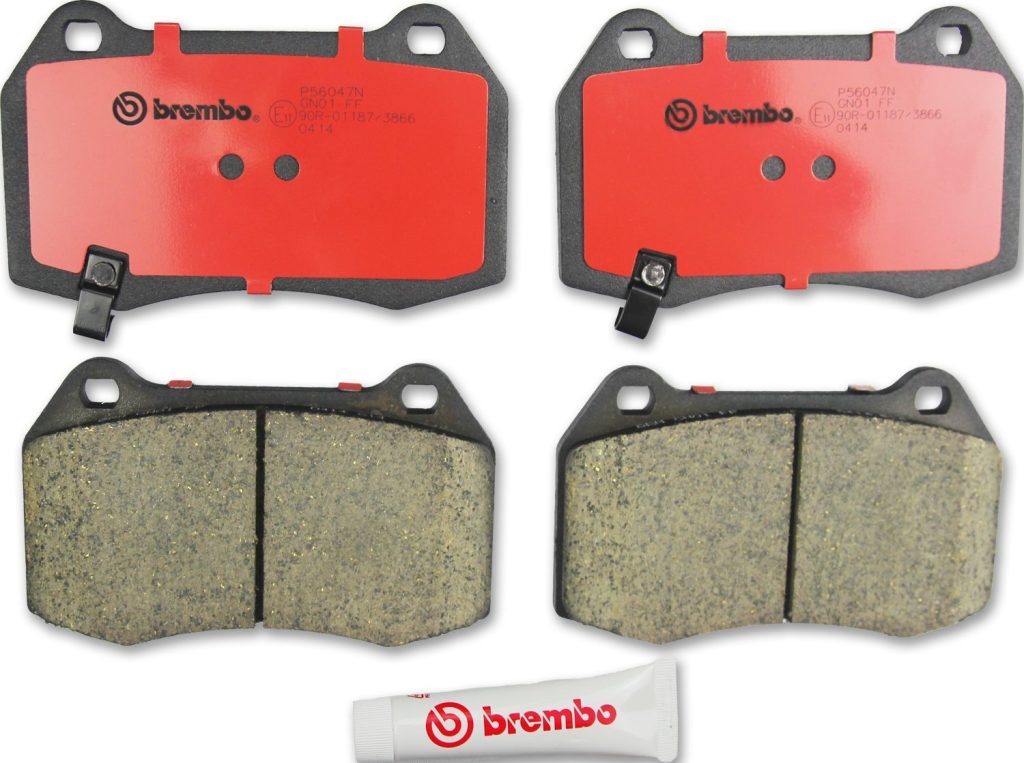
Brembo is a name that carries weight in braking, but the P56047N ceramic pad set is not a performance part. It’s a mainstream replacement for certain Honda and Nissan models, and judging it by track-day standards misses the point. This review looks at what these pads actually deliver in daily driving, where they fit, and where they fall short.
The P56047N fits a range of Honda and Nissan vehicles, including the Honda Accord (certain years), Nissan Altima, and others that use the D10FOCD00C pad shape. It’s a ceramic compound, which means it’s formulated for low dust and quiet operation rather than maximum bite. If you’re replacing worn OEM pads on a commuter car, this is the category you’re shopping in.
In normal use—stop-and-go traffic, highway cruising, the occasional panic stop—these pads behave like good ceramic pads should. Initial bite is moderate, not aggressive, so they feel easy to modulate in low-speed situations. Pedal effort is progressive, and there’s no noticeable grabbiness when cold. That’s a plus for drivers who want predictability over sharpness.
One of the main reasons people choose ceramic pads is dust. The P56047N produces noticeably less wheel dust than semi-metallic compounds, which means less time spent scrubbing brake dust off alloy wheels. It’s not zero-dust, but it’s a clear improvement. Noise is also well-controlled in most cases; during a week of mixed driving, we didn’t experience squealing or groaning, though as with any pad, proper installation and hardware condition matter.
Brembo includes a shim and chamfered edges to help with noise reduction, and the pads come with the necessary hardware for a basic install. The friction material is designed for longevity, and while we can’t verify exact wear rates without a long-term test, ceramic pads typically last longer than semi-metallic ones in normal driving. That said, they can be harder on rotors if the rotors are already worn or if the pads are not bedded in properly.
Here’s where the trade-off comes in: ceramics trade off some high-temperature performance for their low-dust, low-noise characteristics. If you frequently drive in mountainous terrain, tow a trailer, or do any spirited driving, these pads may fade earlier than a semi-metallic or performance ceramic pad. They’re simply not designed for sustained hard use. For the vast majority of daily drivers, that’s an acceptable compromise, but it’s worth knowing if your driving goes beyond the ordinary.
Compared to a basic semi-metallic pad, the P56047N offers cleaner wheels and quieter operation at the expense of initial bite and heat resistance. Compared to a dedicated performance pad, it gives up stopping power and fade resistance for civility and low maintenance. It sits in the middle of the road, which is exactly where most commuters want to be.
Who is this for? It’s for the owner of a Honda or Nissan who wants a straightforward brake pad replacement that won’t dust up their wheels or squeal at every stoplight. It’s for the driver who values smooth, predictable braking over sharp response. It’s also for someone who does their own brake work and wants a known brand with decent quality control.
Who is it not for? It’s not for the enthusiast who takes their car to track days or autocross events. It’s not for someone who regularly carries heavy loads or drives in demanding conditions. And it’s not for someone looking for the absolute lowest price—there are cheaper pads out there, though they may not offer the same balance of dust, noise, and longevity.
Installation is straightforward for a DIYer with basic tools, but as with any brake job, proper bedding-in is essential to avoid uneven deposits and noise. Brembo provides instructions, and following them will help ensure the pads perform as intended. One minor gripe: the included hardware is basic, and if your calipers or rotors are worn, you’ll want to replace those as well—pads alone won’t fix a tired braking system.
Overall, the Brembo P56047N is a solid choice for a daily driver. It’s not exciting, but it’s not supposed to be. It’s a functional, low-drama pad that does its job without drawing attention. If you’re looking for a sensible replacement for worn-out OEM pads on a Honda or Nissan, this set is worth considering. Just keep your expectations in line with the product’s intent.