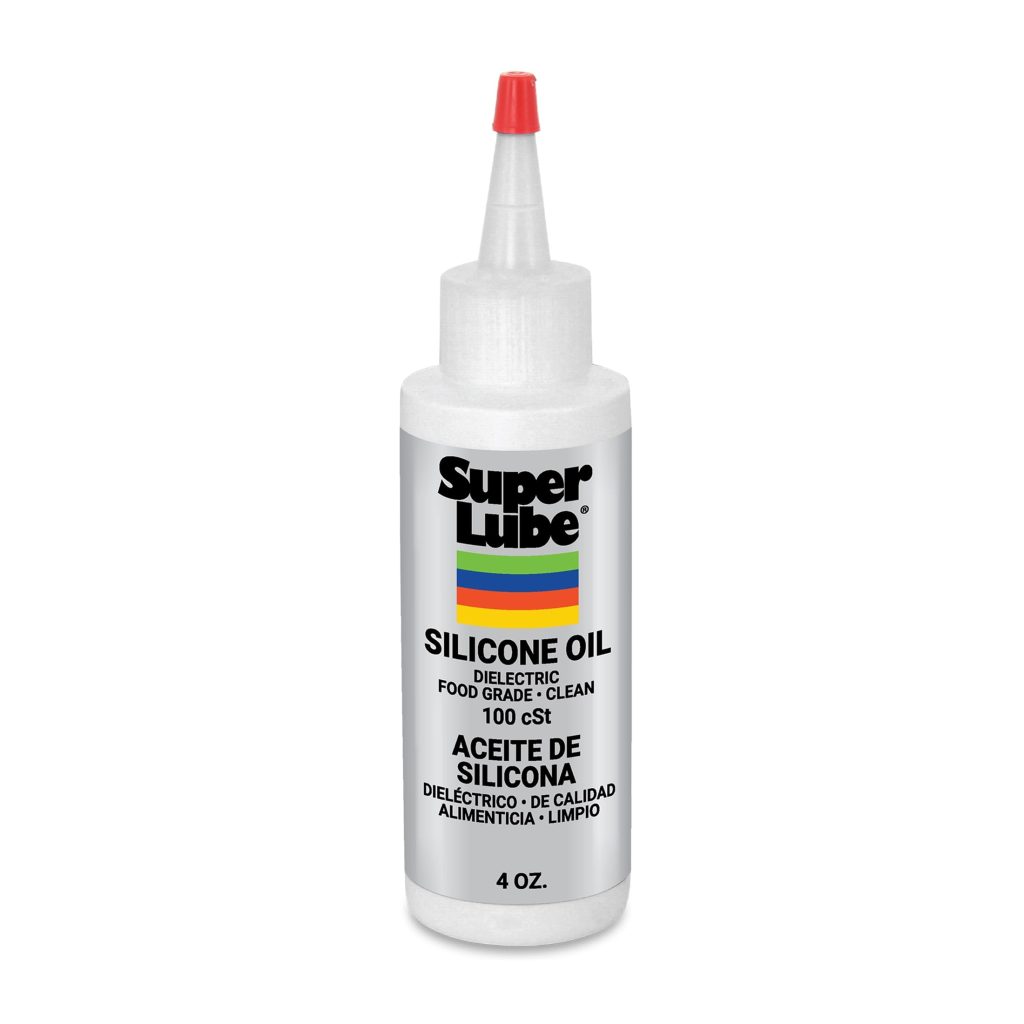
Super Lube’s Silicone Oil High & Low Temp CST is a clear, 4-ounce bottle of silicone-based lubricant designed for applications where temperature swings are a concern. It’s NSF-certified as food-grade (H1) and rated for use in environments from -40°F to 500°F (-40°C to 260°C), making it a niche but potentially useful addition to a workshop, kitchen, or lab. Unlike general-purpose oils, this one is built for stability, not heavy-duty load bearing. It’s a problem-solver for specific scenarios, not a universal fix.
In real-world use, this oil shows up in places where petroleum-based lubricants would fail or pose a contamination risk. Think food processing equipment: meat slicers, conveyor bearings, or filling nozzles that need occasional lubrication but can’t tolerate a non-food-grade oil. It’s also common in laboratories for greasing glass joints or rubber seals, and in HVAC for lubricating valves and O-rings that see both hot and cold cycles. Because it’s silicone-based, it doesn’t gum up or oxidize as quickly as some organic oils, and it remains fluid at low temperatures where thicker greases would stiffen. The 4-ounce bottle has a precision dropper tip, which helps with controlled application—useful when you’re trying to avoid overspray on food-contact surfaces.
Functionally, the key selling point is its wide temperature range. The “CST” in the name refers to centistokes, a measure of kinematic viscosity. This particular grade is 1000 CST, which is relatively thick for a silicone oil—more like a light syrup than water. That viscosity makes it suitable for slow-moving parts and as a release agent, but it also means it won’t wick into tight clearances as easily as a thinner oil. The NSF H1 registration means it’s acceptable for incidental food contact, but it’s not a cleaner or sanitizer; it’s a lubricant. It’s also dielectric, so it can be used on electrical components, though you’d want to verify compatibility with plastics and elastomers first. Silicone oil can cause swelling in some silicone-based rubbers, so testing on a small area is wise.
One limitation is that it’s not a high-pressure lubricant. For metal-on-metal gears or bearings under heavy load, you’d be better off with a lithium grease or a molybdenum disulfide product. This oil is more about temperature stability and chemical inertness than load capacity. Another trade-off: silicone oil can be difficult to remove completely. If you apply it to a surface that later needs to be painted or glued, you’ll need to clean thoroughly with a solvent, as silicone residue can cause adhesion problems. Also, while it’s food-grade, it’s not intended for direct consumption, and you should still follow your facility’s safety protocols. The 4-ounce size is convenient for occasional use, but if you’re lubricating a lot of equipment regularly, you’ll go through it quickly and might want a larger container.
Compared to a PTFE-based dry lubricant, this silicone oil leaves a wet film that can attract dust and debris. That’s a downside in dirty environments. On the other hand, it doesn’t require a carrier solvent to evaporate, so it’s ready to work immediately. Compared to a food-grade mineral oil, silicone oil has better temperature stability and doesn’t break down as fast at high heat, but it’s also more expensive and can be trickier to clean up. If your application involves extreme temperatures and you need a lubricant that won’t carbonize or freeze, silicone oil is a strong candidate. If you’re just trying to quiet a squeaky hinge in a pantry, a cheaper mineral oil will do fine.
Who is this for? It’s best suited for maintenance technicians in food processing, lab managers, and hobbyists working with 3D printers or HVAC systems who need a lubricant that performs across a wide temperature range and won’t contaminate sensitive materials. It’s also handy for lubricating rubber seals and plastic gears where petroleum-based oils would degrade the material. Who is it not for? Anyone looking for a heavy-duty grease for automotive or industrial machinery, or someone who needs a long-lasting lubricant in a dusty environment. It’s also not a substitute for a dedicated release agent in high-volume molding operations—it works, but it’s not the most economical choice. And if you’re on a tight budget, generic silicone oil without the NSF certification might suffice for non-food applications, though you’d sacrifice the assurance of food-grade compliance.
In summary, Super Lube’s Silicone Oil High & Low Temp CST is a specialized lubricant that does one thing well: provide stable lubrication across a broad temperature range without introducing food-safety risks. It’s not a miracle product, and it has clear limitations, but for the right user, it’s a reliable tool. Just don’t expect it to replace your general-purpose grease.


