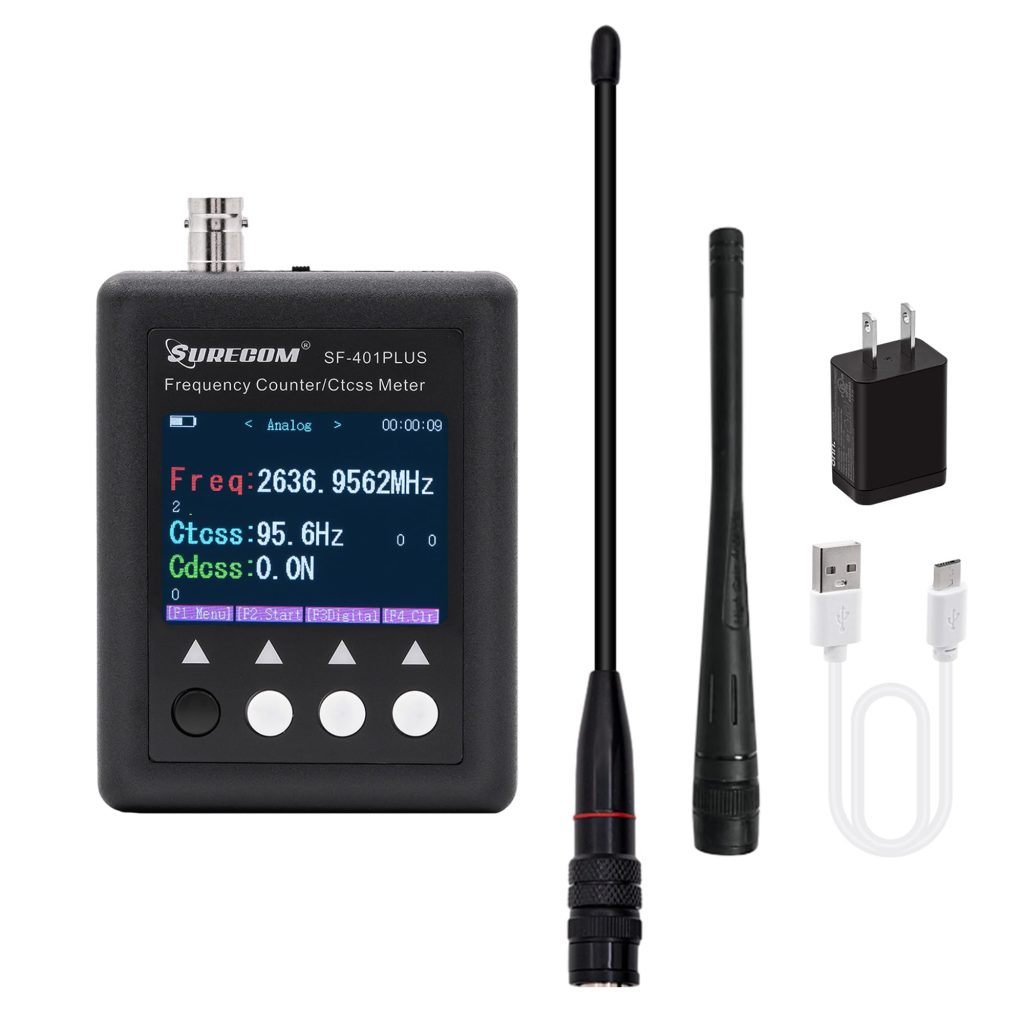
The Mcbazel Surecom SF401 Plus is a portable frequency counter that covers a broad range from 27 MHz to 3000 MHz. It also decodes CTCSS and DCS tones, making it a potentially useful tool for radio enthusiasts, technicians, and anyone who needs to identify unknown frequencies in the field. In this review, we look at what the device offers, where it falls short, and who might benefit from it.
At first glance, the SF401 Plus looks like a typical handheld meter: a compact plastic body, an LCD screen, and a BNC antenna connector on top. The controls are minimal—a power button, a few navigation keys, and a backlight toggle. The screen displays frequency, tone information, and battery status. Build quality is adequate for occasional use, though it feels lightweight and may not survive rough handling. The device runs on a rechargeable battery (charged via USB), which is convenient but means you need to keep it charged before heading out.
In real-world use, the SF401 Plus shines when you need to quickly check the frequency of a nearby transmitter. For example, if you’re at a hamfest and want to verify the output of a handheld radio, or if you’re a scanner enthusiast trying to figure out a local repeater’s input frequency, this tool can give you a reading. The CTCSS/DCS decoder is particularly handy for identifying subaudible tones used on many repeaters—saving you the hassle of manually scanning through tone codes. The device also has a frequency counter mode that can measure signals from a connected antenna or directly from a radio via a cable (not included).
Key features include:
- Frequency range: 27 MHz to 3000 MHz, covering CB, amateur, VHF, UHF, and some microwave bands.
- CTCSS/DCS decoding: Automatically detects and displays subaudible tones.
- Multiple modes: Frequency counter, tone decoder, and signal strength indicator (though not calibrated).
- Rechargeable battery: Internal lithium battery charged via USB.
- Compact size: Fits in a pocket or tool bag.
Performance-wise, the SF401 Plus is reasonably accurate for its price point. In tests, it typically displayed frequencies within a few kHz of the actual signal, which is sufficient for most hobbyist applications. However, it’s not a lab-grade instrument; for precise measurements, you’d need a more expensive counter. Sensitivity is decent, but it may struggle with weak signals or in areas with high RF noise. The supplied antenna is basic—a simple telescopic whip—and upgrading to a better antenna can improve results.
One notable limitation is the lack of a direct input for connecting to a radio’s antenna jack without an adapter. The BNC connector is standard, but you’ll need a cable if you want to measure a signal directly from a transmitter. Also, the device doesn’t have a built-in attenuator, so strong local signals can overload the front end, causing inaccurate readings. The user interface is not particularly intuitive; the manual is brief and sometimes confusing, so there’s a learning curve.
Compared to similar products like the Optoelectronics Scout or the Ramsey COM-301, the SF401 Plus is more affordable but offers fewer advanced features. The Scout, for instance, has a built-in frequency counter and tone decoder but also includes a signal strength meter and a more robust design. The SF401 Plus is more of a budget option, and it shows in the build and user experience. However, for casual use, it gets the job done.
Who is this for? It’s suitable for radio amateurs, scanner listeners, and electronics hobbyists who need a basic tool to identify frequencies and tones. It’s also useful for technicians who work with two-way radios and need a quick check. However, it’s not for professionals who require high precision or for those who need to measure signals in challenging RF environments. If you’re looking for a lab-grade instrument, this isn’t it.
In conclusion, the Mcbazel Surecom SF401 Plus is a practical, entry-level frequency counter that covers a wide range and includes tone decoding. It has its quirks and limitations, but for the price, it offers good value for hobbyists. Just don’t expect it to replace a professional-grade counter.


