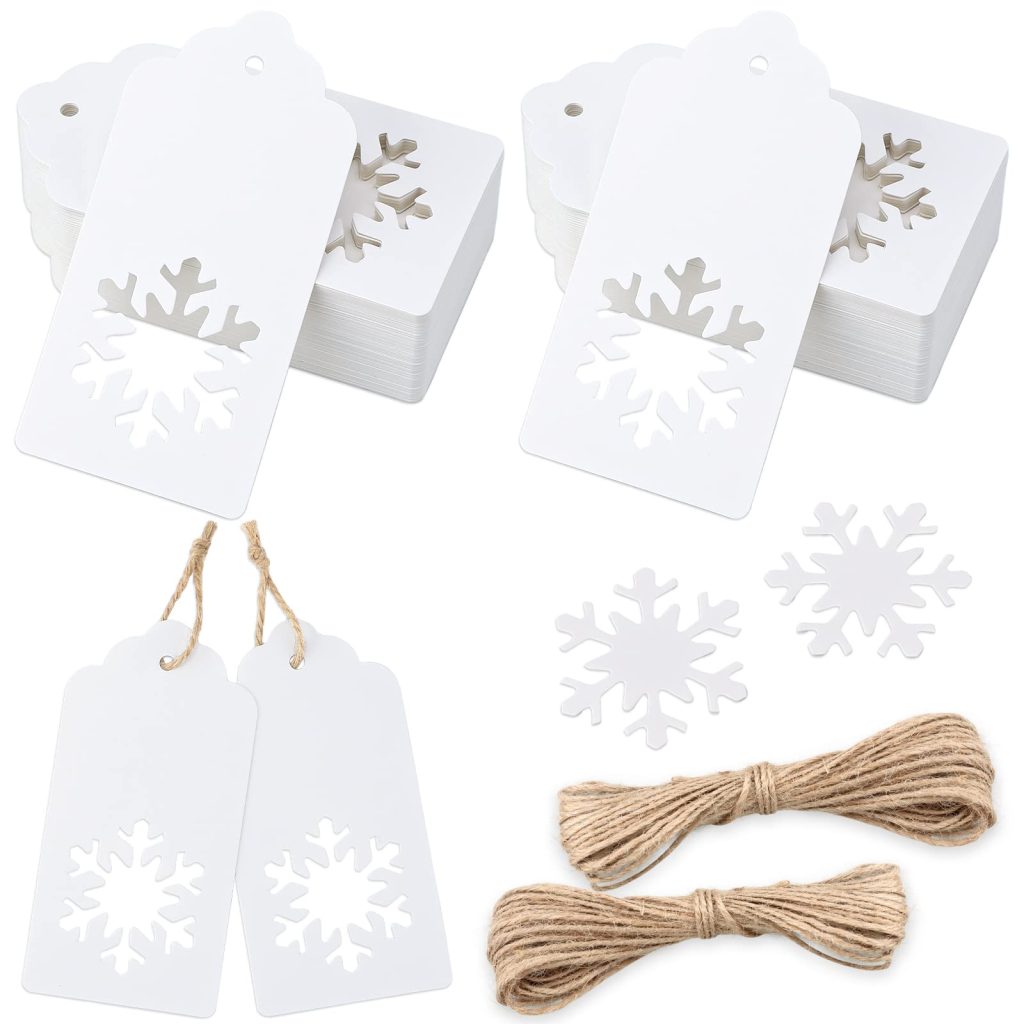
jijAcraft’s 100-piece Christmas tag set sits in a crowded corner of the holiday market: bulk paper tags sold in large counts, priced low, and intended for people who want to label gifts, jars, and party favors without spending much. The set consists of white paper tags with die-cut hollow shapes—trees, Rudolph figures, and snowflakes—each threaded with string. They are blank on the writing surface, which is the point: you supply the names and messages yourself. Whether that trade-off works for you depends on how much effort you want to put into presentation.
The most common use case is straightforward. You have a pile of wrapped gifts, gift bags, or mason jars of homemade preserves, and you need something to write a name on. The tags are small enough to hang from a ribbon or twine loop, and the pre-attached string saves the step of hunting for your own. For classroom parties, office gift exchanges, or a large family gathering, the count of 100 is the main selling point—it means you are not rationing tags or reusing last year’s crumpled ones. They also work for non-gift labeling: craft fair price tags, pantry jar labels, or place settings at a holiday table.
Functionally, the paper stock is on the lighter side. It takes ballpoint pen and fine-tip marker reasonably well, but heavier gel pens and felt-tip markers can bleed or feather, especially if you write slowly. If you plan to use calligraphy pens or brush markers, expect some show-through on the reverse and possible feathering at the die-cut edges. The hollow shapes—trees, reindeer, snowflakes—are the visual identity of the set, and they read clearly at a glance, but the cutouts also reduce the usable writing area. On the tree and Rudolph shapes in particular, the blank space for a name is narrower than on a plain rectangular tag, so long names or short messages need to be planned around the cutout.
The string is a practical inclusion but not a premium one. It is thin and functional, adequate for tying to a bag handle or jar neck, but it is not the sort of cord you would choose if you wanted the tag itself to look decorative. Knots hold, though the string can slip loose on smooth surfaces like glass jars if you tie it loosely. For permanent attachment, a small piece of tape or a tighter double knot helps.
Compared with plain manila or kraft shipping tags—the kind sold in office supply aisles—these are more festive and better suited to holiday presentation, but the kraft tags are typically sturdier and offer more uninterrupted writing space. Compared with printed, pre-designed gift tags, these require you to do the writing and decorating, which is either the appeal or the drawback depending on the buyer. If you want a finished look straight out of the package, printed tags are the better choice. If you want a blank canvas for handwriting, stamping, or adding washi tape, these fit that role.
One limitation worth noting is consistency. In bulk sets at this price point, minor variation in string length, hole placement, and cutout alignment is common, and buyers should expect the occasional tag where the string is knotted short or the die-cut edge is slightly rough. None of this affects usability, but it means the set is not a precision product. The paper also is not designed for outdoor use or for anything that will get wet; moisture will soften the stock and the string alike.
These tags suit people planning a large-scale holiday event, crafters who enjoy personalizing labels, and anyone labeling jars or favors in quantity. They are less suitable for shoppers who want elegant, ready-to-use tags for a formal dinner, for calligraphers needing bleed-resistant paper, or for anyone who needs tags that will survive shipping or handling. As a low-cost, high-count labeling supply, the set does what it claims; the quality is adequate rather than impressive, and the blank surface is a feature to be used, not a flaw to be overlooked.