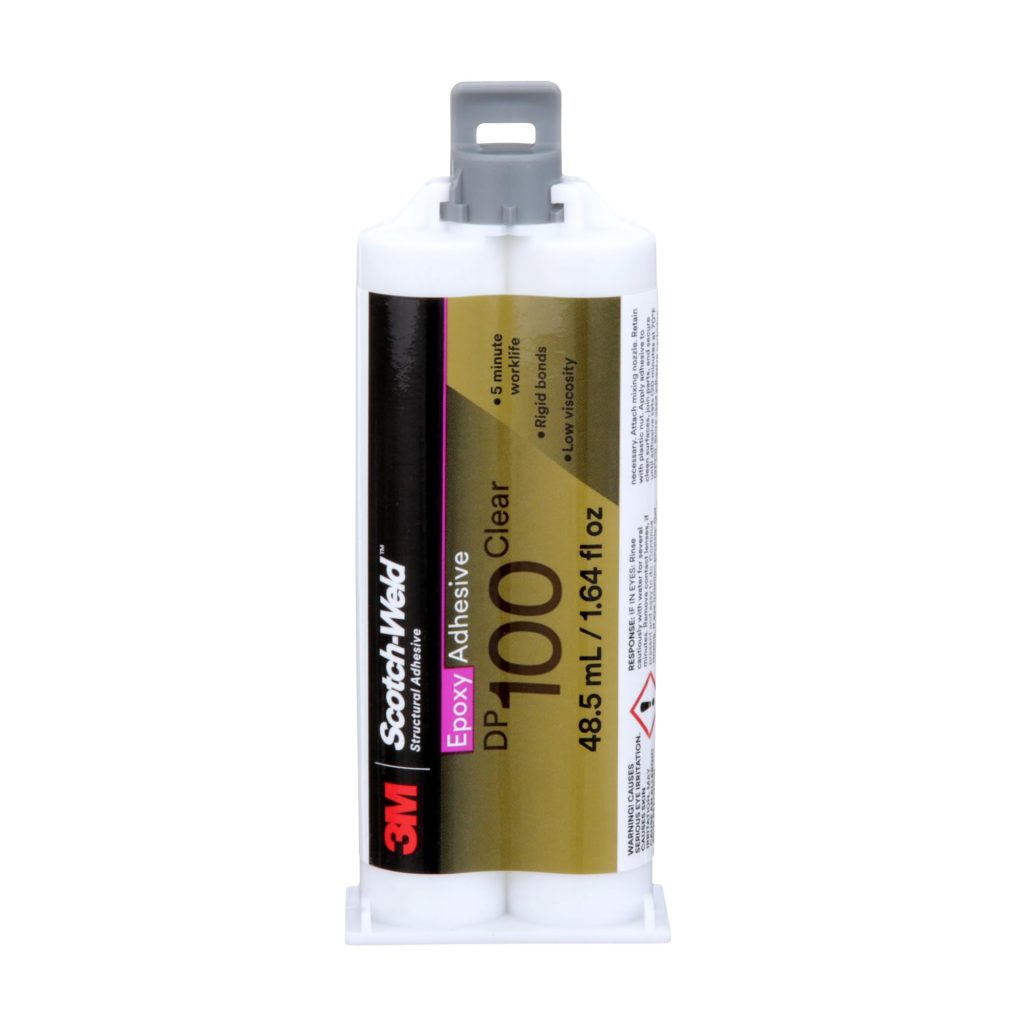
3M’s Scotch-Weld DP100 is one of those workshop staples that tends to be bought out of habit rather than enthusiasm. It is a two-part, room-temperature-curing epoxy supplied in a 48.5 mL Duo-Pak cartridge, which means the resin and hardener sit in separate side-by-side chambers and are metered through a mixing nozzle when dispensed. The clear formulation is the version most people encounter first, and it occupies a useful middle ground between hardware-store five-minute epoxies and slower, stronger structural adhesives.
The Duo-Pak format is the main reason to consider it. Because the two components are combined automatically as they pass through the nozzle, there is no measuring, no stirring, and no ratio errors. For anyone who has ruined a batch of epoxy by eyeballing the mix, that consistency is worth something. A standard dispensing gun is required, though, and that is a real cost to factor in if you do not already own one. The cartridge is not squeezable by hand in any practical sense.
In use, DP100 behaves as a general-purpose structural adhesive. It bonds well to metals, glass, ceramics, many rigid plastics, and wood, and it handles modest gaps reasonably well compared with thin cyanoacrylates. The clear color is helpful on visible joints and light-colored materials where a dark adhesive line would show. Working time is around four to five minutes at typical room temperature, which is enough to position parts and apply light clamping but not enough to fuss over alignment. Handling strength arrives fairly quickly, and full cure is typically reached overnight, depending on temperature and bond-line thickness.
Cured performance is respectable but should be understood in context. On clean, well-prepared metal and rigid substrates, a properly executed joint holds up to normal handling and moderate load. It is not a substitute for welding or mechanical fasteners on load-bearing structures, and it does not tolerate sustained high heat particularly well. Like most room-temperature epoxies of this type, strength drops off as temperatures climb, so anything near engine bays, hot pipes, or prolonged direct sun exposure deserves a more heat-resistant product. Surface preparation matters a great deal; oily or poorly abraded metal will produce a joint that fails earlier than the adhesive itself is capable of.
- Format: 48.5 mL dual-chamber cartridge with self-mixing nozzle; requires a compatible dispensing gun.
- Cure profile: Roughly 4–5 minutes working time, handling strength within a short window, full cure overnight at room temperature.
- Appearance: Clear cured bond, useful for visible or light-colored assemblies.
- Substrates: Metals, glass, ceramics, rigid plastics, and wood with appropriate surface prep.
The most common frustration is the nozzle. Mixing tips are consumables, and once epoxy sets inside one it is finished. Short jobs often waste a tip, and if the cartridge sits between uses, cured material can clog the outlet. Some users get around this by dispensing a small amount and capping, but the cleanest results come from using a fresh tip per session. The cartridge also cannot be partially mixed to order the way bulk two-part systems can, so very small jobs may leave unused material to cure in the package.
Compared with a standard two-tube syringe epoxy, DP100 trades low upfront cost for convenience and repeatability. A syringe kit is cheaper and needs no gun, but mixing is manual and consistency varies. Compared with toughened structural epoxies such as methacrylate adhesives, DP100 is generally less forgiving on flexible or poorly prepared surfaces and less tolerant of impact, but it is simpler to apply and cures without the strong odor some methacrylates carry. It also sits below high-temperature and flexible epoxy lines in specialized performance, which is expected given its general-purpose positioning.
This product suits people doing repeat bonding work where consistent mixing and clean dispensing matter: model and prototype assembly, small metal fabrications, glass and ceramic repair, and shop tasks that recur often enough to justify the gun and tips. It is a sensible choice for light structural repairs around the home or workshop where joints are clean and loads are modest.
It is less suitable for one-off repairs where the cost of a dispensing gun and nozzles is hard to justify, for high-temperature environments, for flexible or impact-heavy joints, and for anyone unwilling to prepare surfaces properly. Buyers expecting a miracle adhesive for dirty or oily metal will be disappointed. Treated as a reliable, convenient general-purpose epoxy with clear limits, DP100 does its job without drama.