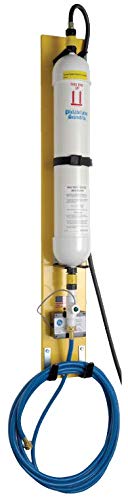
Forklift batteries and other lead-acid battery systems require periodic watering with pure water to prevent mineral buildup that can shorten battery life. The Philadelphia Scientific Hydropure Water Deionizer System is designed to produce that water on-site by removing dissolved solids from tap water. This review examines how the system works in real-world settings, its key features, and where it might not be the right fit.
In operations with electric forklifts, battery watering is a routine task. Using tap water directly introduces calcium, magnesium, and other ions that can coat battery plates and interfere with charging. The Hydropure system addresses this by deionizing water through a two-stage process. Water first passes through a carbon filter to remove chlorine and organic compounds, then through a mixed-bed ion exchange resin that exchanges cations and anions for hydrogen and hydroxyl ions, effectively removing dissolved minerals. The resulting water typically has a conductivity of less than 10 microsiemens per centimeter, which meets most battery manufacturers’ specifications for watering.
The system is available in different configurations, including wall-mounted and portable units. It connects to a standard water supply and uses a pressure-driven flow, so no electricity is required. The output capacity varies by model, but most units can produce several hundred gallons of deionized water before the resin needs replacement. A built-in meter or indicator light signals when the resin is exhausted, taking the guesswork out of maintenance. The system also includes a pre-filter that should be replaced periodically to protect the resin bed.
One of the practical advantages of the Hydropure is that it eliminates the need to purchase and store bottled distilled or deionized water. For facilities that water batteries daily, this can reduce ongoing costs and simplify logistics. The system is relatively compact and can be installed near the battery charging area, making it convenient for operators. The use of standard fittings and tubing means installation is straightforward for someone with basic plumbing skills.
However, there are limitations to consider. The ion exchange resin is not permanent; it must be replaced when exhausted, and the replacement cartridges are a recurring expense. The frequency of replacement depends on the mineral content of the incoming water and the volume of water used. In areas with very hard water, the resin may deplete quickly, leading to higher operating costs. Additionally, the system does not remove all contaminants—it is designed specifically for deionization, not reverse osmosis or distillation. It will not remove bacteria or other microorganisms, so if the water source is not potable, additional treatment may be needed.
Another trade-off is the initial purchase price. While the Hydropure can save money over time compared to buying bottled water, the upfront cost is higher than a simple water filter. For small operations that water batteries infrequently, the payback period may be long. It is also worth noting that the system requires some maintenance: pre-filters need changing, and the resin cartridge replacement involves some hands-on work. If maintenance is neglected, water quality can degrade without obvious signs until battery problems occur.
Compared to alternative methods, such as purchasing distilled water in jugs or using a reverse osmosis system, the Hydropure offers a middle ground. Distilled water is convenient but costly and generates plastic waste. Reverse osmosis systems can produce high-purity water but are typically more expensive and waste more water. The Hydropure’s ion exchange approach is efficient and produces minimal wastewater, but it requires more frequent cartridge changes than a reverse osmosis membrane, which can last years with proper pre-filtration.
Who is this for? The Hydropure is best suited for medium to large warehouses, distribution centers, or manufacturing facilities that operate fleets of electric forklifts and perform regular battery watering. It is also a good fit for operations that want to reduce their environmental footprint by eliminating bottled water deliveries. It is not ideal for individuals with a single forklift or occasional battery watering needs, as the cost and maintenance may outweigh the benefits. Similarly, if your tap water has extremely high mineral content, you may find the resin depletes too quickly to be economical.
In summary, the Philadelphia Scientific Hydropure Water Deionizer System is a practical solution for producing battery-quality water on-site. It offers convenience, reduces waste, and can lower long-term costs for high-volume users. But it is not a set-and-forget device; it requires regular maintenance and has ongoing cartridge expenses. Potential buyers should assess their water usage and water quality to determine if the system makes sense for their operation.