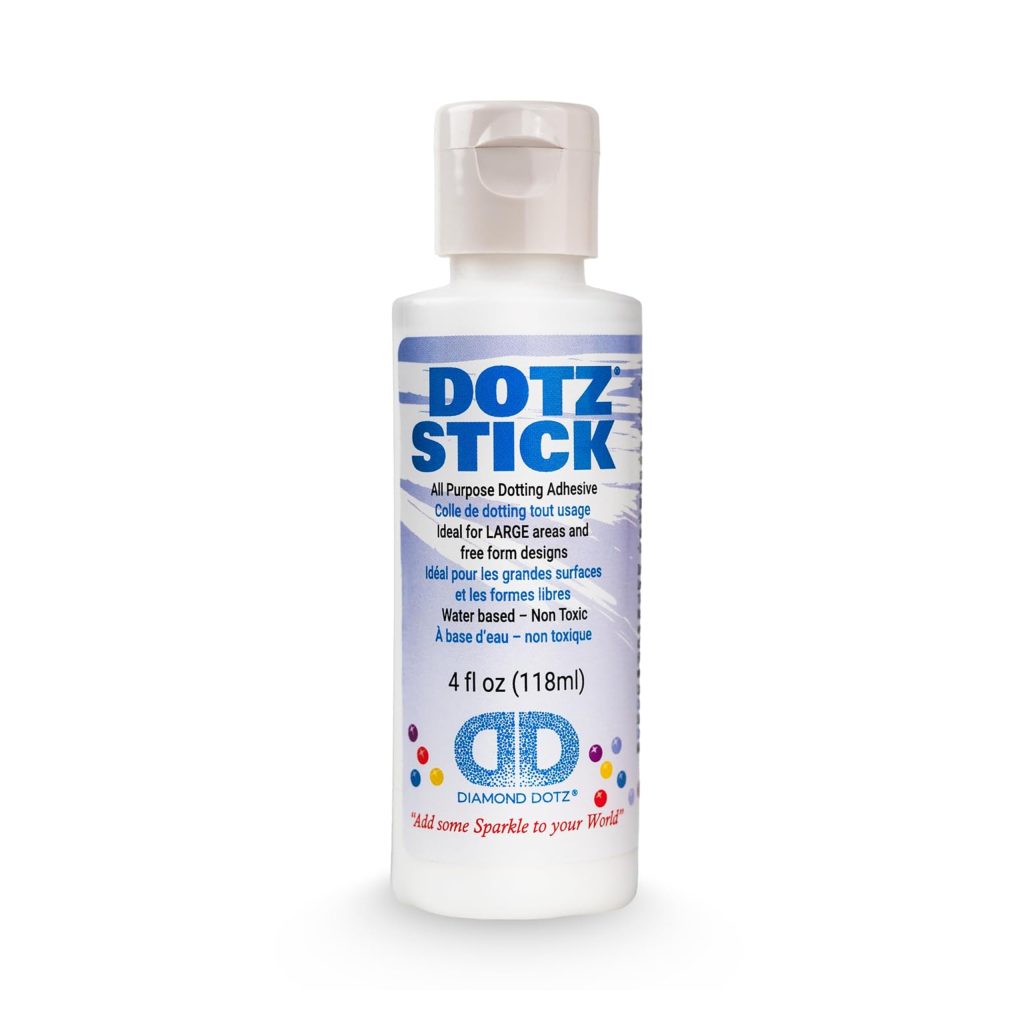
Diamond painting has a way of revealing its weak points after a few completed canvases. Drills sit slightly crooked, a few refuse to stick at the edges, and the ones near a frame or a high-traffic corner tend to pop off over time. Diamond Dotz Stick Adhesive Glue is a small, clear adhesive aimed at exactly those situations: spot-fixing drills, securing edges, and handling small craft repairs where a dedicated wax or putty isn’t practical.
The product is a clear liquid glue sold in a small tube with a fine applicator tip. That tip matters more than it might seem. Diamond painting involves placing tiny resin drills with a pen or tweezers, and any adhesive that dispenses in a thick blob is essentially unusable for that scale. The narrow nozzle allows a dot small enough to sit under a single drill without smearing across the canvas symbol underneath. The glue dries clear, which is the main reason it’s marketed for this use rather than a generic craft glue, since visible residue on a finished canvas is hard to forgive.
In practice, the glue is used in two different ways. The first is repair work: lifting a misaligned or fallen drill, applying a tiny amount to the canvas or the back of the drill, and pressing it back into place. The second is reinforcement, particularly along canvas edges or around sections that will be framed or handled. Some crafters also use it for non-diamond-painting tasks, such as attaching small embellishments to cards or securing flat-backed gems to fabric and paper. It behaves like a general-purpose clear craft adhesive in those contexts, which broadens its usefulness but also means it isn’t uniquely formulated for resin drills.
Functionally, the glue is a solvent-based clear adhesive that bonds to paper, canvas, plastic, and most resin surfaces. It sets relatively quickly on porous materials and takes longer on non-porous ones like the resin drills themselves. Working time is short enough that repositioning a drill after the glue starts to tack is difficult, so placement needs to be reasonably accurate on the first attempt. The tube is small, which is appropriate for the intended use but runs out faster than expected if someone uses it for larger reinforcement jobs rather than spot fixes.
There are real trade-offs. The most significant is that this is not a replacement for the adhesive canvas itself. It’s a repair and reinforcement tool, not a way to convert a non-sticky surface into a diamond painting canvas. Applying it across a large area would be slow, uneven, and expensive given the tube size. The solvent smell is noticeable when the cap first comes off, and while it dissipates, it’s worth noting for anyone sensitive to fumes or working in a small, unventilated room. On some darker canvases, a heavy application can leave a faint sheen even after drying, so less is genuinely more.
Compared with the alternatives, the choice comes down to format. Diamond painting wax and putty are the standard tools for picking up and holding drills during normal placement, and they remain better for that job because they’re reusable and don’t dry out. Glue enters the picture when wax isn’t strong enough, such as a drill that keeps falling off or an edge that needs a permanent bond. Generic clear craft glues can do similar work, but they often come in larger bottles with wider nozzles, making precision harder. A fine-tip glue pen is another option and is easier for some users to control, though pens tend to clog if not cleaned regularly. Diamond Dotz Stick occupies a middle ground: more precise than a bottle of craft glue, more permanent than wax, and simpler than maintaining a glue pen.
This product suits people who have completed at least a canvas or two and want a small repair kit on hand, as well as crafters who do mixed media work and want a clear adhesive with a fine applicator. It is less suitable for beginners still learning basic drill placement, since wax is the more relevant tool at that stage, and for anyone planning to glue large sections or seal an entire canvas, where a dedicated sealant or a larger-volume adhesive makes more sense. Buyers should also expect a small quantity; this is a touch-up tube, not a bulk supply.
Overall, the Diamond Dotz Stick Adhesive Glue does a narrow job competently. It isn’t a essential purchase for every diamond painter, but for the specific problems it targets, crooked drills, loose edges, and small craft fixes, it’s a reasonable and appropriately sized solution. The main caveats are the short working time, the solvent odor, and the limited volume, none of which are deal-breakers for spot use but all of which shape what the product is realistically good for.