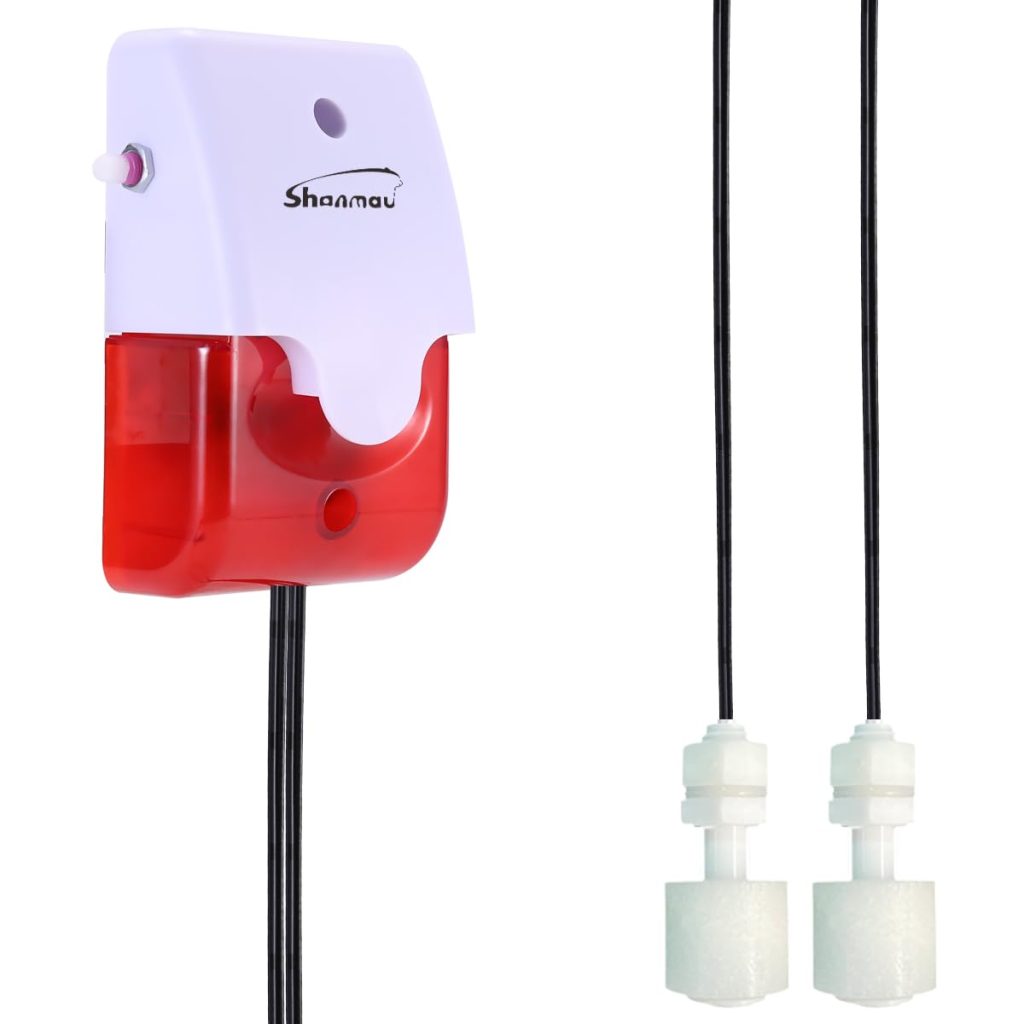
Water damage is one of those problems that’s far cheaper to prevent than to repair. A small leak from a sump pump, an overflowing aquarium, or a forgotten basement drain can cause thousands in damage if left unchecked. The High/Low Water Level Sensor Detector Alarm aims to give you an early warning with a loud 120 dB siren and a red strobe light. It’s a simple device: a float switch on a 16.4-foot cord connects to an alarm unit that you mount wherever you can hear it. The idea is to place the float at the water level you want to monitor, and when water rises (or falls) to that point, the alarm sounds.
In real-world use, this kind of sensor is typically deployed in three scenarios: as a high-level alarm in a sump pit to warn of pump failure, as a low-level alarm in a tank to indicate when it’s running dry, or as a leak detector in a basement or near a water heater. The float switch itself is a mechanical component—a bobber that tilts when water reaches it, triggering the alarm. The 16.4-foot cord gives you decent reach, so you can place the alarm unit in a living area while the float sits in a remote sump or tank.
The alarm unit itself offers adjustable volume, which is a thoughtful touch. A 120 dB siren is extremely loud—roughly equivalent to a jet engine at close range—so being able to dial it down is important if you’re using it in a living space. The red strobe adds a visual alert for noisy environments or for those with hearing impairments. The unit can be set to trigger on high water (rising) or low water (falling), depending on how you orient the float. That dual functionality makes it versatile for different applications.
Installation is straightforward: mount the alarm unit with screws or double-sided tape (not included), hang the float at the desired level, and connect the cord. The float switch is not designed for continuous submersion in all liquids—it’s best for clean water. In dirty water or water with debris, the float mechanism can get stuck, leading to false alarms or missed alerts. That’s a notable limitation for sump pits, which often contain some sediment.
Another trade-off is that this is a local alarm only. There’s no Wi-Fi, no app, no text message. If you’re not within earshot, you won’t know there’s a problem. For some users, that’s fine—a basement alarm that wakes you up at night is enough. But if you travel or want remote monitoring, you’ll need a smart water sensor instead, like those from Moen or Govee, which offer app notifications. Those cost more and may require a hub, but they provide peace of mind when you’re away.
Performance-wise, the alarm is loud and the strobe is bright. The adjustable volume works as expected, though even at lower settings it’s still quite audible. The float switch responds quickly when water hits the trigger point, but there is a slight delay—maybe a second or two—as the float tilts. That’s typical for mechanical floats. The 16.4-foot cord is a good length for most residential sump pits or aquariums, but if you need to cover a larger area, you might need a longer cord or multiple units.
Build quality is adequate for the price. The plastic housing feels a bit basic, and the cord is not as thick as some industrial sensors. But for indoor use, it should hold up. The alarm unit is not waterproof, so it must be mounted away from splashes. The float itself is waterproof, of course. It’s also worth noting that the alarm requires a 9V battery (not included) or an AC adapter (also not included). That’s a minor annoyance—you’ll need to factor in the extra cost.
Who is this for? It’s suitable for homeowners who want a simple, loud, local alarm for a sump pit, basement, or aquarium. It’s also useful for DIY enthusiasts who want a basic sensor without smart features. It’s not for those who need remote notifications or integration with a smart home system. It’s also not ideal for monitoring dirty water or outdoor applications where the float could freeze or get clogged. And if you need to monitor a large area, a single float may not be enough.
Compared to a smart water leak sensor, this is a more manual, self-contained solution. Smart sensors offer remote alerts and can be part of a larger system, but they often cost more and rely on Wi-Fi. This alarm is a one-trick pony, but it does that trick reliably. If you just need a loud noise when water reaches a certain level, this will do it.
In summary, the High/Low Water Level Sensor Detector Alarm is a practical, no-frills device that serves a specific purpose. It’s loud, adjustable, and easy to install, but it lacks remote monitoring and may struggle with dirty water. For the right user, it’s a cost-effective safeguard against water damage.


