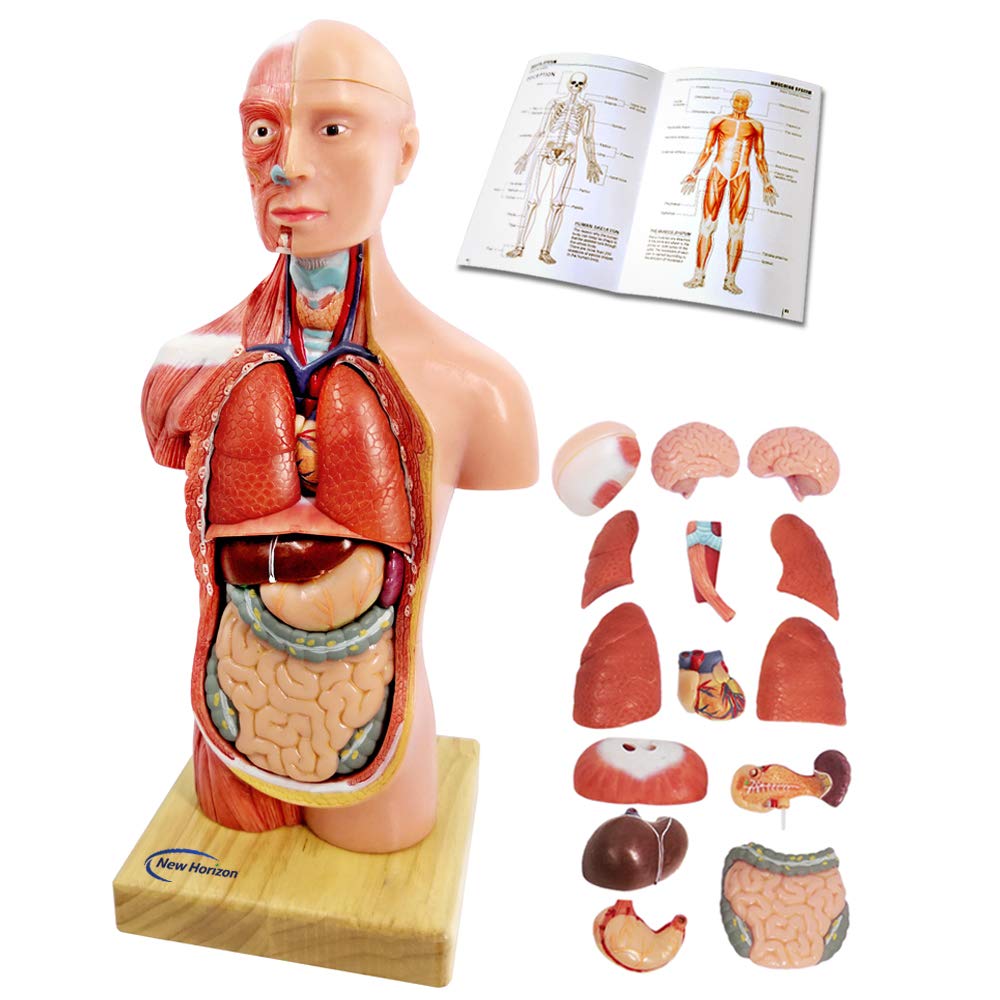
Anatomy models occupy a strange space in education: they’re either flimsy plastic toys that frustrate students or expensive professional-grade replicas that few can afford. The Generies 15-piece removable 3D human torso model, at 11 inches tall, tries to land in the middle. After examining its design and typical use cases, it’s clear this is a tool aimed at casual learners, not medical professionals—and that’s fine, as long as you know what you’re getting.
In practice, this model is most often used by middle and high school students studying human biology, by homeschooling parents who want a tangible supplement to textbook diagrams, and occasionally by fitness trainers or yoga instructors who need a visual aid for explaining muscle groups and organ placement. It’s also a common purchase for curious adults who want a hands-on refresher on basic anatomy. The 11-inch size is a deliberate compromise: large enough to show detail, small enough to sit on a desk without dominating it. The 15 removable parts include the torso shell, brain, lungs, heart, liver, stomach, intestines, and kidneys, among others. Each piece is designed to fit into the body cavity with a friction fit, and the model comes with a stand for upright display.
Functionally, the model does what it claims: organs can be removed and replaced, and the pieces are labeled with numbers that correspond to a key (usually printed on the base or included as a sheet). The plastic is lightweight but feels reasonably durable for normal handling—though it’s not the kind of material that would survive being dropped on a hard floor repeatedly. The heart and lungs are molded as single units, which simplifies reassembly but means you can’t separate them for closer study. That’s a trade-off worth noting: more pieces would allow finer detail, but also more frustration when pieces don’t align perfectly. The friction fit is generally secure, but some users report that certain organs (especially the intestines) can be fiddly to seat properly, and repeated removal may loosen the fit over time.
One of the model’s strengths is its visual clarity. The organs are painted in distinct, realistic colors—red for the heart, pink for the lungs, brown for the liver—which helps with identification and makes the model more engaging than a monochrome diagram. The torso shell is transparent on one side in some versions, allowing a view of the organs in place, though the Generies model appears to have a solid flesh-toned exterior with a removable front panel. This is a minor point, but it affects how you use the model: with a solid panel, you’re always removing pieces to see inside, which is fine for study but less convenient for quick demonstrations.
Compared to a standard anatomical chart or a textbook illustration, the 3D model offers obvious advantages in spatial understanding—you can hold the heart in your hand and see how it sits relative to the lungs. But compared to a higher-end model (say, one from a brand like 3B Scientific), the Generies falls short in precision and material quality. The detailing is simplified: the brain is a single piece without internal structures, and the kidneys lack the finer anatomical features you’d find on a professional model. For a high school student, this is probably sufficient; for a nursing student, it’s likely too basic.
Who is this for? It’s a good fit for middle and high school students, homeschoolers, and anyone who wants a low-cost, hands-on introduction to human anatomy. It’s also useful for patient education in a clinic setting, where a simple visual aid can help explain basic concepts. Who is it not for? Medical students, anatomy professors, or anyone needing precise anatomical accuracy for professional training. The simplified details and plastic construction won’t meet those standards. Also, if you’re looking for a model that can withstand heavy classroom use year after year, you might want to invest in something more robust.
In terms of real-world performance, expect the model to serve its purpose for occasional study sessions and demonstrations. It’s not a tool you’ll use daily for hours, but for reviewing organ placement before a test or explaining the digestive system to a child, it works. The stand is a nice touch for display, though it’s lightweight and can tip if bumped. Assembly instructions are minimal—most users figure it out by trial and error, which is part of the learning process but can be frustrating for younger students.
Overall, the Generies 15-piece torso model is a reasonable entry-level educational tool. It won’t wow anyone with its craftsmanship, but it doesn’t need to. At its price point, it offers a tangible way to explore anatomy that’s more engaging than a book and more affordable than a professional model. Just go in with realistic expectations: this is a study aid, not a precision instrument.