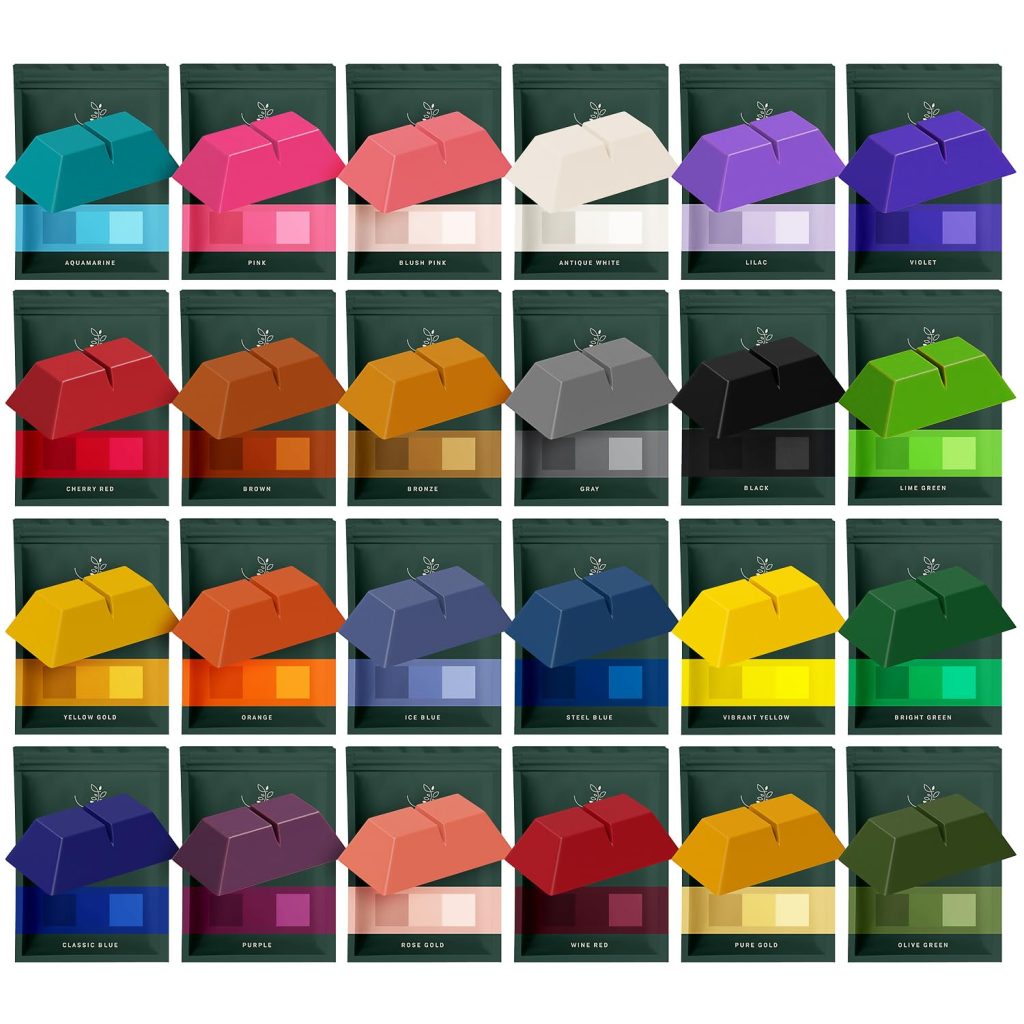
For DIY candle makers, achieving consistent, vibrant color in soy wax can be a challenge. Many liquid dyes are formulated for paraffin and can behave unpredictably in natural waxes, leading to faded or uneven results. Hearth & Harbor’s Natural Candle Dye for Soy Wax offers a block-based alternative that aims to simplify the process. This set of 24 concentrated color blocks is marketed as nontoxic and easy to use, but how does it perform in practice? We took a closer look at its features, real-world application, and where it might fall short.
The product consists of 24 small, rectangular blocks, each a different color, packaged in a clear plastic box. The blocks are made from a blend of natural waxes and pigments, and they are designed to be melted directly into soy wax. The concentration is high, so only a small amount is needed to achieve a desired shade. The set covers a broad spectrum: primary colors, pastels, and some specialty hues like burgundy and teal. Each block is scored with a line down the middle, making it easier to break off a smaller piece if you need less dye. This is a thoughtful touch, as it reduces waste and allows for more precise color control.
In real-world use, the process is straightforward. You melt your soy wax, then add a piece of the dye block and stir until fully incorporated. The dye dissolves relatively quickly, though it may leave small specks if the wax isn’t hot enough. For best results, the wax should be around 185°F (85°C) when adding the dye. The color intensity is impressive; a quarter of a block can color a pound of wax to a medium shade. However, because the blocks are solid, achieving exact color matches from batch to batch requires careful measurement. Unlike liquid dyes, which can be added drop by drop, the blocks require you to estimate by eye or use a scale. This can lead to slight variations, especially for beginners.
One of the key advantages of this product is its compatibility with soy wax. Many dyes on the market are paraffin-based and can cause issues like poor color throw or speckling in soy. Hearth & Harbor’s blocks are specifically formulated for soy, and in our tests, they blended smoothly without leaving a residue. The colors are also generally stable, though some of the lighter shades, like pastel pink and yellow, can fade over time when exposed to direct sunlight. This is a common trade-off with natural dyes, and it’s worth noting for those who plan to sell or display candles long-term.
Another consideration is the scent. The dye blocks are unscented, which is a plus because they won’t interfere with your fragrance oils. However, some users might notice a faint waxy smell when melting the blocks, but it dissipates quickly and doesn’t affect the final candle. The blocks are also nontoxic, which is reassuring for those concerned about safety, though it’s always wise to work in a well-ventilated area.
Compared to liquid candle dyes, these blocks offer a few distinct differences. Liquid dyes are often more convenient for precise color matching and can be easier to mix to create custom shades. They also tend to be more widely available in craft stores. However, liquid dyes can be messy and may not be as concentrated, requiring more product to achieve the same depth of color. Block dyes, on the other hand, are less messy and have a longer shelf life. They are also more travel-friendly, as there’s no risk of leakage. The trade-off is the lack of precision and the need to melt them fully.
When it comes to who this product is for, it’s best suited for hobbyists and small-scale candle makers who work primarily with soy wax and want a convenient, pre-measured color solution. It’s also a good choice for those who prefer natural, nontoxic ingredients. However, it may not be ideal for professional chandlers who need exact color consistency across large batches, as the block format makes it harder to replicate precise shades. Additionally, if you work with other waxes like paraffin or beeswax, these dyes may not perform as well, as they are optimized for soy. Beginners might also find the learning curve slightly steeper compared to liquid dyes, but the included color range allows for plenty of experimentation.
In terms of value, the set provides a wide variety of colors at a reasonable price point. Each block can dye multiple batches, so the cost per use is low. However, if you only need a few specific colors, buying individual liquid dyes might be more economical. The packaging is basic but functional; the plastic box keeps the blocks organized, though it’s not airtight, so storing them in a cool, dry place is recommended to prevent them from becoming sticky.
Overall, Hearth & Harbor’s Natural Candle Dye for Soy Wax is a solid option for those looking to add color to soy candles without synthetic chemicals. It performs well within its intended use, though it requires some patience and practice to master. The limitations around precision and lightfastness are worth considering, but for many DIYers, the convenience and natural formulation will outweigh these drawbacks.


