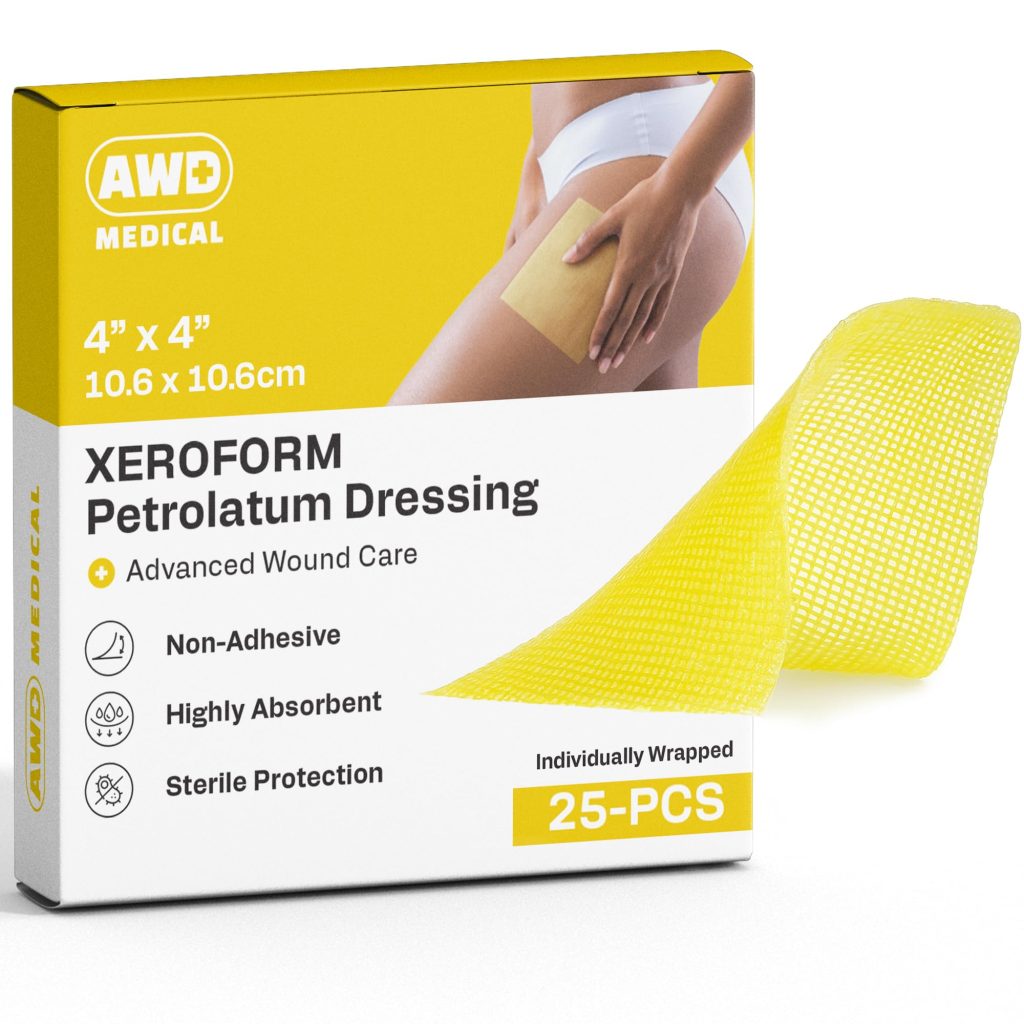
When dealing with burns, skin grafts, or surgical wounds, the choice of dressing can significantly impact healing and comfort. The AWD Medical 4×4 Xeroform Petrolatum Dressing is a non-adherent, sterile mesh gauze that has been a staple in clinical settings for decades. This review looks at its practical use, performance, and limitations based on common experiences.
Xeroform is essentially a fine mesh gauze impregnated with a petrolatum-based ointment containing 3% bismuth tribromophenate. The primary function is to provide a non-stick barrier that allows exudate to pass through while keeping the wound bed moist. In real-world use, this dressing is often applied directly over a wound after cleaning, then covered with secondary absorbent gauze. It is particularly common in burn units, post-skin graft sites, and for minor surgical wounds or lacerations where minimal tissue trauma during dressing changes is critical.
Key functional features include its non-adherent nature, which helps prevent the dressing from sticking to the wound and causing pain or damage when removed. The petrolatum base maintains a moist environment, which supports faster epithelialization. The mesh structure allows drainage to wick away, reducing the risk of maceration. Each dressing is individually wrapped and sterile, making it convenient for both clinical and home use. The 25-count box is a practical quantity for ongoing care.
However, there are trade-offs. One limitation is that Xeroform does not have strong antimicrobial properties beyond the mild bacteriostatic effect of bismuth. For heavily contaminated or infected wounds, it may not be sufficient alone and would require additional antimicrobial agents or more modern dressings like silver-impregnated foams. Also, the petrolatum base can be messy; it may stain clothing or bedding, and the dressing can slip if not secured properly with tape or a secondary bandage. Some users find that it adheres slightly to very dry wounds, though this is less common than with plain gauze.
Compared to generic petrolatum gauze (like plain Vaseline gauze), Xeroform offers the added bismuth compound, which provides a mild odor-reducing and antibacterial effect. But compared to modern silicone-based non-adherent dressings (such as Mepitel or Silflex), Xeroform is less conformable and may not stick as well to irregular wound shapes. Silicone dressings also tend to cause even less pain on removal, though they are generally more expensive. For most routine burns and surgical wounds, Xeroform remains a reliable, cost-effective middle ground.
Who is this product suitable for? It works well for patients with partial-thickness burns, skin graft donor sites, abrasions, and clean surgical incisions where minimal exudate is expected. It is also a good choice for those who need a simple, proven dressing without the high cost of advanced products. Caregivers at home can use it for minor burns or post-operative wounds, provided they follow proper wound care instructions.
Who might want to look elsewhere? If you have a heavily draining wound, a chronic ulcer, or an infected wound, Xeroform may not provide enough absorption or antimicrobial protection. In those cases, a foam dressing with silver or an alginate might be more appropriate. Also, if you or your patient is sensitive to bismuth or petrolatum, an alternative like plain silicone mesh should be considered.
In practice, the AWD Medical version performs similarly to other Xeroform brands, though some users note that the mesh is slightly stiffer than the original Covidien product. Sterility is maintained well, and the packaging is easy to open. For the price, it is a solid option for standard wound care, but it is not a magic bullet. It is a tool that works best when paired with good wound assessment and appropriate secondary dressings.
Overall, this dressing is a functional, time-tested choice for specific wound types. It does the job without fanfare, but it is not the most advanced or versatile option available. If your situation matches its strengths, it is worth considering.