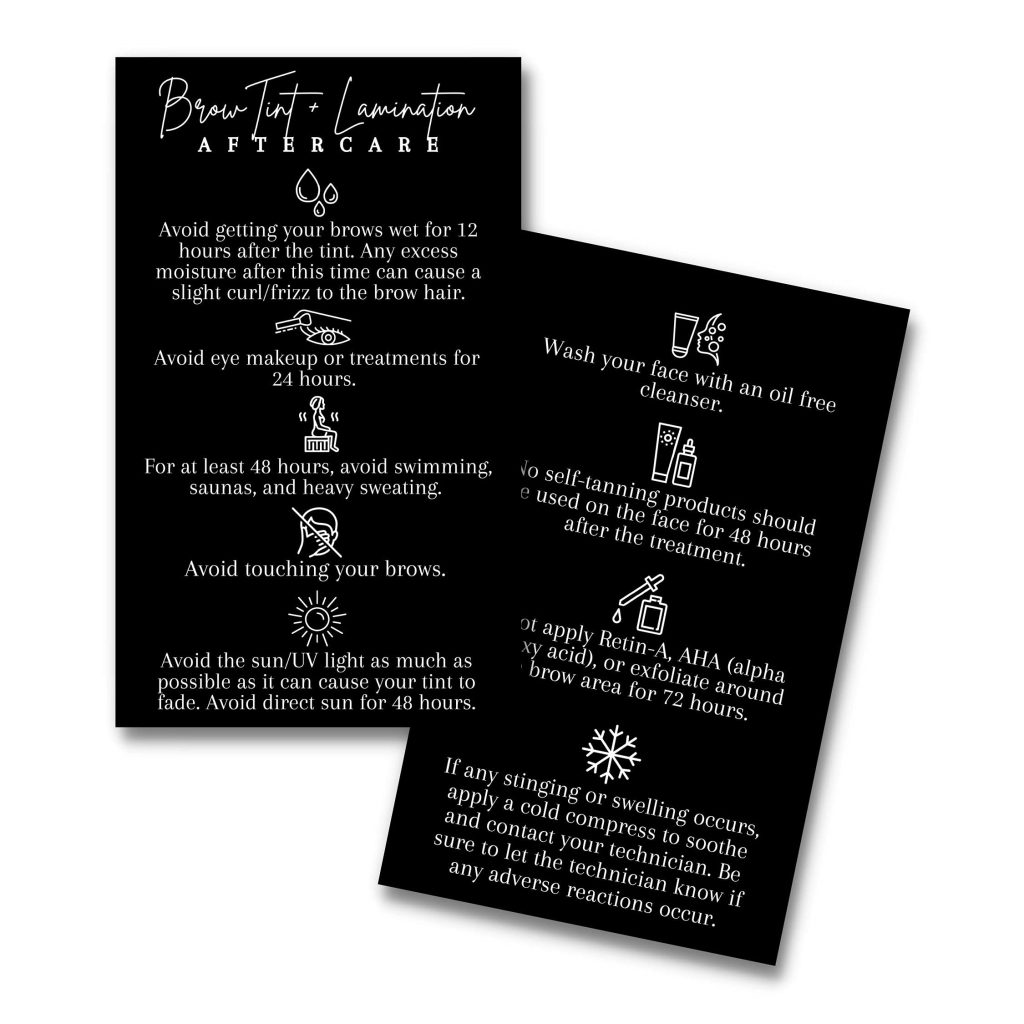
Aftercare instructions are a crucial but often overlooked part of brow tinting and lamination services. Clients invest time and money into these treatments, and proper post-care can significantly affect how long results last and how the brows heal. These printed aftercare cards, sized at 2×3.5 inches (the standard business card size), offer a simple way for technicians to provide written guidance without relying on verbal explanations or digital follow-ups. The cards feature a black and white design, keeping them cost-effective and easy to read. But do they add real value to a brow business, or are they just another upsell? This review examines their practical use, features, and limitations.
In a typical brow studio, after a tint or lamination service, the technician usually runs through a list of do’s and don’ts: avoid water for 24 hours, don’t use oil-based products, brush the hairs daily, and so on. Clients may nod along, but once they leave, details can fade. These cards serve as a physical reminder that clients can stick on their bathroom mirror or keep in their wallet. They are particularly useful for technicians who want to maintain consistency across multiple staff members or ensure that every client receives the same information. The cards are also a subtle branding opportunity if customized, though this particular design is generic black and white.
Functionally, the cards are straightforward. They are printed on cardstock, which gives them a bit more durability than a flimsy flyer, but they are not laminated. That means they can smudge if handled with wet hands or crease if stuffed into a pocket. The black and white design is minimalist, which some may find professional, but others might see as plain. There is no option for color or custom text in this listing; it’s a one-size-fits-all solution. The content on the cards is pre-printed with standard aftercare instructions for brow tint and lamination, covering the essentials like avoiding water, heat, and makeup for the first 24 hours, and moisturizing with a brow conditioner. However, the instructions are not exhaustive; they don’t include specific advice for different skin types or reactions, so technicians may need to supplement verbally.
One of the main limitations is the lack of customization. Every brow artist has their own preferred aftercare routine, and the pre-printed text may not align perfectly with your specific instructions. For example, some technicians recommend avoiding water for 48 hours, while these cards say 24. If you want to add your studio’s contact information or a logo, you’d need to print labels or stamp them, which adds time and cost. Additionally, the cards are not individually wrapped, so they come in a bulk stack, which is fine for a busy studio but might be overkill for a solo artist who sees only a few clients a week. The black and white printing also means they can’t be customized to match your brand colors without an additional printing step.
Compared to digital aftercare solutions, such as sending a follow-up email or text with instructions, these cards have the advantage of being tangible. Clients are more likely to glance at a card on their vanity than to scroll back through old messages. However, digital options allow for links to videos or more detailed explanations, which these cards cannot provide. Another alternative is a small aftercare booklet, which can hold more information but costs more and may be overkill for a simple brow service. The cards strike a balance between being informative and affordable.
Who are these cards suitable for? They work best for brow technicians who want a quick, no-fuss way to reinforce aftercare instructions. They are ideal for high-volume studios where speed and consistency matter, or for mobile artists who need something lightweight to hand out. They are also a good option for those who prefer a minimalist aesthetic. On the other hand, they are not suitable for technicians who want fully customized aftercare that matches their brand voice and specific protocols. If you already provide a detailed digital aftercare guide or a more comprehensive printed booklet, these cards might feel redundant. Also, if your clients often have questions or need more detailed guidance, these cards alone won’t suffice.
In terms of value, the cards are reasonably priced, especially when bought in bulk. They are a small investment that can help reduce client confusion and potentially extend the life of the brow tint or lamination. However, they are not a magic solution; they won’t replace the need for clear verbal communication and proper technique. The cardstock quality is adequate for short-term use, but if you want something that will last longer in a client’s purse, you might consider laminating them yourself or opting for a more durable material, which would increase the cost.
Overall, these aftercare cards are a practical, no-nonsense tool for brow professionals. They won’t wow anyone with design, and they lack customization, but they get the job done. If you’re looking for a simple way to provide written aftercare without spending a lot, these cards are worth considering. Just be prepared to add your own touches to make them fit your brand and specific instructions.


