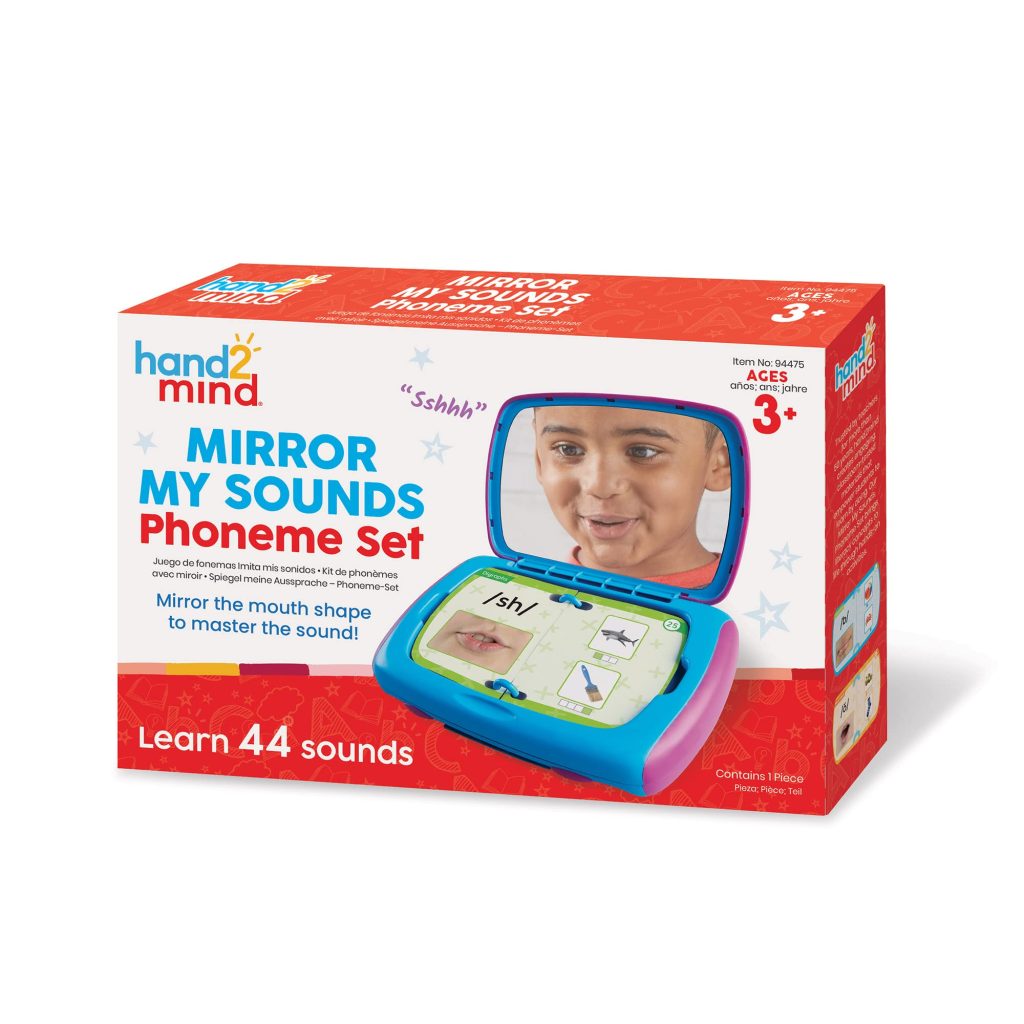
Phonemic awareness—the ability to hear and manipulate individual sounds in words—is a foundational skill for reading. The hand2mind Mirror My Sounds Phoneme Set is a hands-on resource designed to support this skill in children ages 3 and up. It combines a set of sound cards with a child-safe mirror, allowing kids to see their mouth movements as they practice saying different phonemes. This review examines how the set works in practice, its strengths, and where it might fall short.
What’s in the set and how it works
The set includes 44 sound cards, each featuring a phoneme (a distinct unit of sound) along with a picture cue and the corresponding letter or letter combination. The cards are color-coded by category: consonants, short vowels, long vowels, digraphs, and r-controlled vowels. A double-sided mirror is also included—one side is a standard mirror, and the other side has a slightly magnified view to help children focus on their mouth. The idea is simple: a child selects a card, says the sound while looking in the mirror, and observes how their lips, tongue, and teeth are positioned. This visual feedback can be particularly helpful for children who struggle to distinguish between similar sounds, like /f/ and /th/ or /b/ and /p/.
Real-world use in homes and classrooms
In practice, the set is most often used in one-on-one or small-group settings. A parent, teacher, or speech therapist might introduce a few cards at a time, modeling the sound and then letting the child try. The mirror adds an element of self-correction—children can see if their mouth is in the right position. For example, when working on the /m/ sound, a child can see their lips pressed together. The cards are sturdy and laminated, so they hold up to frequent handling. The mirror is made of shatter-resistant plastic, which is a thoughtful safety feature for young children.
Beyond phonemic awareness, the set can support articulation practice. Speech-language pathologists sometimes use similar mirrors to help children with speech sound disorders. While this set is not a substitute for professional therapy, it can be a useful supplemental tool. The picture cues on the cards also help build vocabulary, as each card shows an object that starts with the target sound (e.g., a sun for /s/).
What works well
- Visual feedback: The mirror provides immediate, concrete feedback that many children find engaging.
- Structured progression: The color-coded categories make it easy to introduce sounds in a logical order, from simpler consonants to more complex vowel patterns.
- Durability: The cards and mirror are built to withstand regular use by young children.
- Versatility: The set can be used for phonemic awareness, articulation, and vocabulary building.
Limitations and trade-offs
One notable limitation is that the set focuses exclusively on phonemes in isolation. While this is valuable, some children may need practice blending sounds into words or manipulating sounds within words (e.g., deleting or substituting phonemes). For that, additional materials or activities are necessary. Also, the mirror is small—roughly the size of a child’s face—so it works best for individual use. In a group setting, you’d need multiple mirrors or take turns, which can slow the pace.
Another consideration is the lack of digital integration. In an era where many educational tools offer apps or online components, this set is entirely analog. That’s not inherently bad—screen-free learning is a plus for many families—but it means there’s no automated tracking or adaptive difficulty. Progress depends on the adult’s observation and record-keeping.
Finally, the set is not a comprehensive reading curriculum. It’s a supplemental tool. Children who are already reading fluently may find it too basic, while those with significant speech or language delays might need more intensive support than this set alone can provide.
How it compares to alternatives
In the broader category of phonemic awareness materials, there are several options. Some programs, like Heggerty or Kilpatrick’s Equipped for Reading Success, offer scripted lessons and a more systematic scope and sequence. Those are better suited for classroom-wide instruction. Other tools, such as magnetic letter tiles or Elkonin boxes, focus on manipulating sounds without the mirror component. The Mirror My Sounds set carves out a niche by combining auditory and visual feedback in a simple, portable format. It’s less structured than a full program but more interactive than plain flashcards.
Who it’s for—and who it’s not
This set is a good fit for parents, preschool teachers, and special educators working with children ages 3 to 6 who are just beginning to explore sounds. It’s also useful for older children who need remediation in specific phonemes, though the picture cues might feel babyish to some. It’s not ideal for large classrooms without additional mirrors, nor for children who already have strong phonemic awareness and are ready for more advanced phonics. It’s also not a standalone solution for speech therapy; it’s a tool that can complement professional guidance.
Overall, the hand2mind Mirror My Sounds Phoneme Set is a practical, well-made resource that does one thing well: it helps children connect the sounds they hear with the mouth movements they make. It’s not flashy, and it won’t replace a structured reading program, but for focused practice, it’s a solid addition to an early literacy toolkit.


