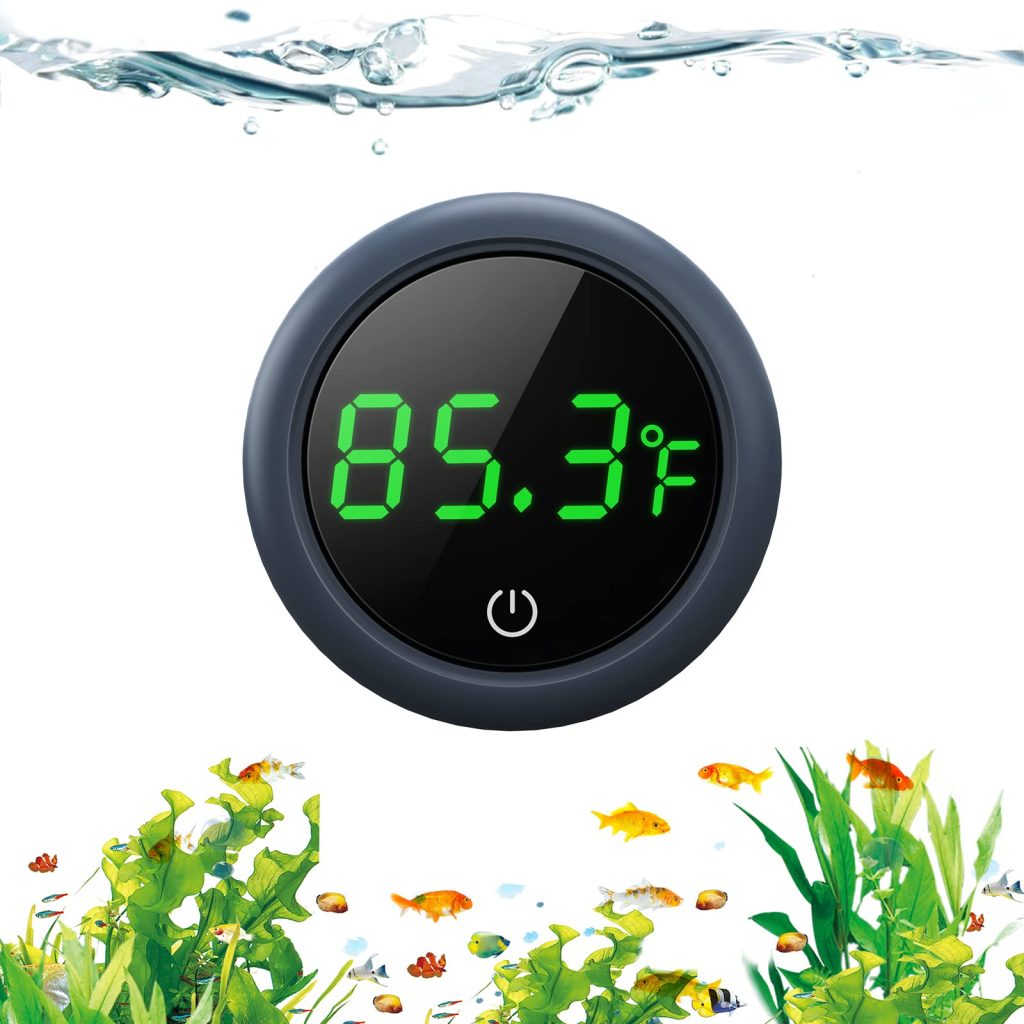
When it comes to maintaining a healthy aquarium, temperature stability is one of those quiet but critical factors. Most fish and invertebrates are ectothermic, meaning their body temperature and metabolic processes are directly tied to the water around them. A swing of even a few degrees can stress fish, invite disease, and disrupt the biological filter. So a reliable thermometer isn’t a luxury—it’s basic equipment. The PAIZOO Digital Aquarium Thermometer is one of many low-cost digital options on the market, and in this review, we’ll look at what it offers, where it falls short, and who might find it useful.
At its core, the PAIZOO is a simple device: a digital display unit connected to a probe on a wire. The probe goes in the water, the display stays outside, and you get a temperature reading. This design is common among budget digital thermometers and for good reason—it keeps the electronics dry and lets you read the temperature without touching the tank. The PAIZOO typically comes with a suction cup for mounting the probe inside the glass and a small stand or adhesive pad for the display. It’s powered by a button-cell battery, usually included.
In real-world use, you’d stick the probe to the inside of the tank, somewhere with good water flow but away from the heater’s immediate output. The display can sit on a nearby shelf or attach to the outside of the tank. The wire is long enough for most standard aquariums, though on very large tanks you might need to get creative with routing. The reading updates every few seconds, which is fine for monitoring trends. It’s not a lab instrument, but for everyday aquarium keeping, that’s acceptable.
Accuracy is the headline claim, and here the PAIZOO is generally decent for its price. Most units are rated to ±1°C (±2°F), which is in line with other budget digital thermometers. In practice, that means if your water is truly 78°F, the display might read 77°F or 79°F. For most freshwater and many saltwater setups, that margin is tolerable, but if you’re keeping sensitive species like discus or certain corals, you’ll want to cross-check with a more precise instrument. It’s also worth noting that the probe can be affected by placement—if it’s near a heater or in a dead spot, the reading may not reflect the overall tank temperature.
One of the main advantages of a digital thermometer like this is readability. The LCD display shows the temperature in large digits, often with a switch between Celsius and Fahrenheit. That’s a step up from glass thermometers, which can be hard to read, especially if they’re covered in algae or viewed at an angle. The PAIZOO also typically has a min/max memory function, which can be useful for spotting temperature swings over a day. That’s a feature you won’t find on a basic glass thermometer.
But there are trade-offs. The probe and wire are the weak points. Over time, the suction cup may lose its grip, especially in warmer water, and the probe can become coated with biofilm, which can slightly insulate it and affect accuracy. Cleaning it gently with a soft cloth or soaking in vinegar can help, but it’s an extra maintenance step. The wire itself is thin and can be damaged by curious fish or by being pinched against the tank rim. Also, the battery isn’t user-replaceable on some models—you have to replace the whole unit when it dies, which is wasteful and annoying. It’s worth checking the specific model before buying.
Compared to a traditional glass thermometer, the PAIZOO offers easier reading and additional features like min/max memory. But glass thermometers are essentially bulletproof—no batteries, no wires, no electronics to fail. They’re also cheaper. On the other hand, a glass thermometer can break, and the metal weights some use can corrode. For someone who wants a quick, clear read and doesn’t mind a bit of maintenance, digital is convenient. For a low-tech, set-and-forget approach, glass might be better. There are also more expensive digital thermometers with higher accuracy and remote sensors, but for most hobbyists, the PAIZOO’s performance is sufficient.
So who is this for? It’s a good fit for beginner to intermediate aquarists with freshwater or hardy saltwater tanks who want an affordable, easy-to-read thermometer. It’s also handy as a secondary thermometer to cross-check against a primary one. It’s not suitable for advanced reef keepers who need precise temperature control, nor for those who want a completely maintenance-free solution. If you have a large tank with sumps and multiple heaters, you might need more than one thermometer anyway, and the PAIZOO’s wire length could be a limitation. Also, if you’re someone who dislikes dealing with batteries and wires, a glass thermometer might be less hassle.
In summary, the PAIZOO Digital Aquarium Thermometer does what it says: it provides a digital temperature reading for your tank at a low cost. It’s not the most accurate or durable option out there, but it’s a practical tool for everyday monitoring. Just go in with realistic expectations—it’s a budget device, and it performs like one. For many aquarists, that’s perfectly fine.


