The GemOro Auracle Pen Probe is not a standalone gold tester, and that distinction matters more than any spec on the box. It is a replacement probe designed to fit the AuRACLE Analyzer and AuRACLE PRO testers. If you already own one of those units and your probe has worn out, gone missing, or started giving erratic readings, this is the part you buy. If you are shopping for a first gold-testing device, this product will not help you, because there is nothing for it to plug into.
That narrow scope is worth stating plainly, because listings for this probe tend to appear alongside full tester kits, and the confusion is common. The probe itself is a small handheld component that connects to the main analyzer body. In practice, a jeweler, pawnbroker, or reseller places the probe tip against an item, and the connected analyzer reports the karat or platinum reading. The probe is the point of contact, so its condition directly affects whether readings are stable or noisy.
The plug-and-play claim holds up in the sense that no calibration software or pairing step is involved. You connect the probe to a compatible AuRACLE unit and continue working as before. For a busy counter where the tester is used dozens of times a day, that matters. A probe that requires fiddling or re-seating between readings slows down the whole workflow, and this one is designed to slot in and stay put.
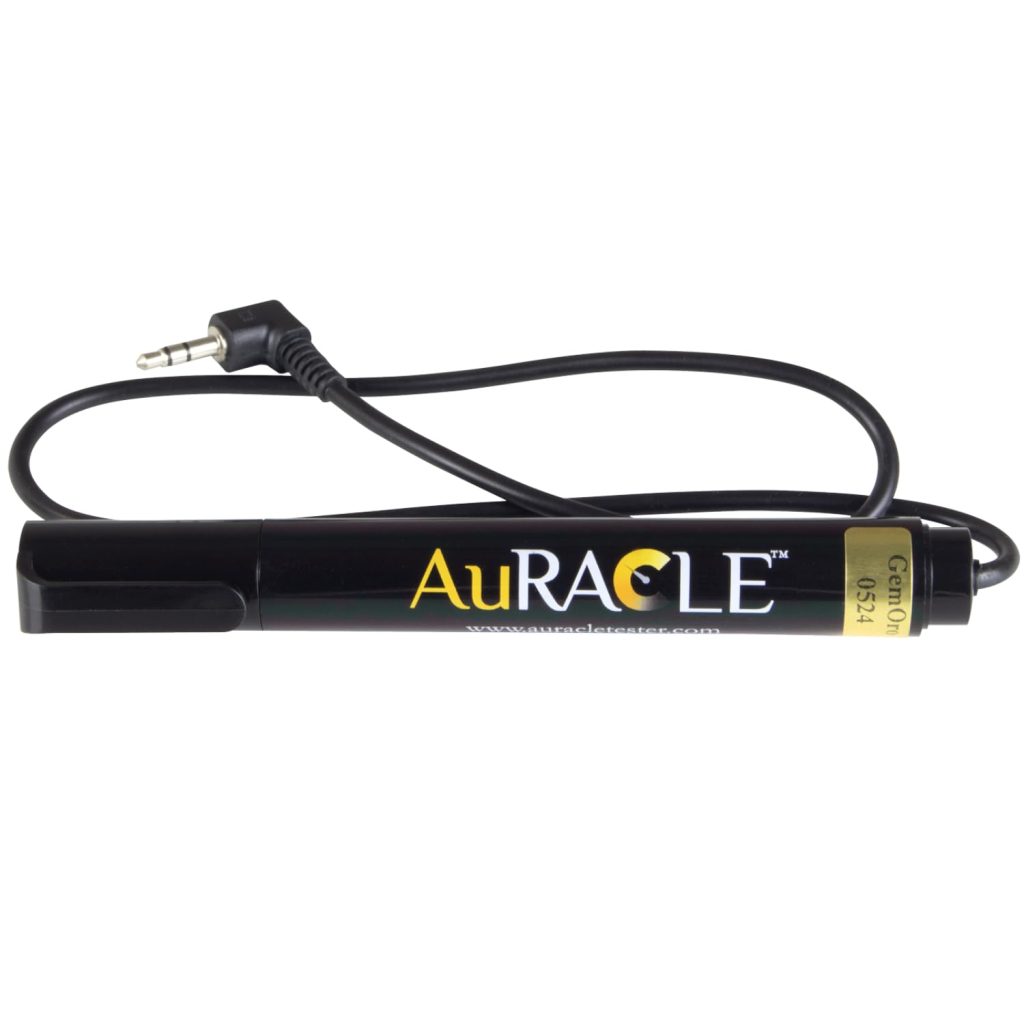
Build quality is consistent with the rest of the AuRACLE ecosystem: a slim pen-style body with a rigid tip and a short cable. It feels like a tool rather than a toy, though it is not armored. The tip is the vulnerable part. Drop it on a hard floor or press too firmly against a stone setting, and you can damage the contact point. Treat it like the precision instrument it is, and it should last through normal use.
- Compatibility: Works with AuRACLE Analyzer and AuRACLE PRO testers only. It is not interchangeable with other brands or older GemOro models.
- Function: Serves as the contact probe that relays readings to the analyzer body; it does not test or display results on its own.
- Installation: Direct connection with no setup or calibration routine required.
- Form factor: Pen-style housing with a fixed cable, sized for one-handed use at a counter or bench.
Accuracy is the obvious question, and the honest answer is that the probe can only be as accurate as the analyzer it is attached to. A fresh probe on a well-maintained AuRACLE unit should restore the readings you had when the device was new. A fresh probe on a unit with a drifted sensor or a tired battery will not fix those problems. Some buyers expect a new probe to solve every reading inconsistency, and that is not how these systems work. If your analyzer is due for service, replace the probe and service the unit together.
Compared with the alternative of sending the whole tester in for repair, buying a replacement probe is cheaper and faster, provided the fault is actually in the probe. That is the trade-off: you save money and downtime if you diagnose correctly, but you waste both if the problem lies elsewhere. A generic third-party probe is another option, and it may cost less, but compatibility with the AuRACLE’s electronics is not guaranteed. For a device used to make purchase decisions on precious metals, an off-brand contact point is a false economy.
Real-world use looks fairly mundane. A pawn shop clerk tests a ring before making an offer. A jeweler checks a customer’s inherited chain. A scrap buyer sorts a bag of mixed pieces. In each case, the probe is touched to the metal, sometimes after a light cleaning, and the reading appears on the analyzer. The probe’s job is to make consistent contact and transmit a clean signal. There is no display, no battery, and no user-facing feedback, which means a failing probe can be hard to identify until readings start jumping around.
One limitation worth flagging is that the probe offers no visual indicator of wear. You find out it is failing through inconsistent results, which can erode trust in the tester itself. Keeping a known reference piece on hand helps isolate whether the probe or the analyzer is at fault. It is a small habit that saves a lot of second-guessing.
This probe is suitable for current AuRACLE owners who have a confirmed probe problem and want an OEM replacement without shipping the whole unit out. It is not suitable for anyone without a compatible analyzer, anyone hoping to upgrade an older or different-brand tester, or anyone expecting the probe alone to improve accuracy on a device that needs service. Within that audience, it does what a replacement part should: it restores function without drama.