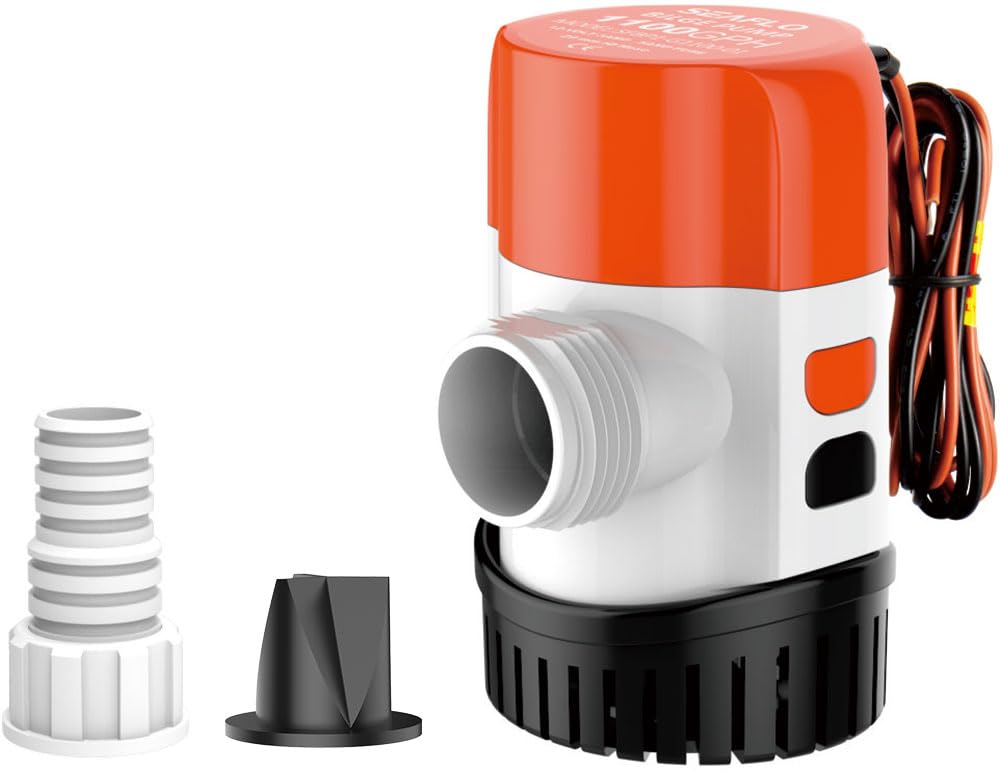
Bilge pumps are one of those boat components you hope never to need, but when you do, reliability matters more than almost anything else. The SEAFLO 13B Series 800 GPH automatic bilge pump is a 12-volt submersible pump designed for smaller vessels, tenders, and as a backup in larger boats. It combines electronic water sensing with a cartridge motor design and carries a four-year warranty. But how does it hold up in real-world use? This review examines its features, performance, and where it fits in the market.
At its core, the 13B Series is an automatic pump that activates when it detects water, thanks to electronic sensing rather than a traditional float switch. This means no moving parts to jam or stick—a common failure point in mechanical switches. The pump is rated at 800 gallons per hour (GPH) with an 18-foot head, which is respectable for a pump of this size. It has a 1-inch and 1-1/8-inch outlet, giving some flexibility in hose sizing. The anti-airlock feature helps prevent the impeller from getting stuck due to trapped air, a problem that can plague pumps after they’ve been dry or after a rough ride.
The cartridge motor design is another notable aspect. It allows the motor to be replaced without removing the entire pump housing, which can simplify maintenance. The pump is submersible and designed for continuous duty, though like most pumps in this class, it’s not intended to run dry for extended periods. The electronic sensing turns the pump on when water is present and off when it’s gone, which should reduce battery drain compared to manual switches left on.
In real-world usage, this pump is typically installed in the bilge of small boats—think runabouts, skiffs, or tenders up to around 20 feet. It’s also a common choice as a secondary pump in larger vessels, where it might handle nuisance water or serve as a backup to a higher-capacity primary pump. The automatic operation is convenient for boats that sit in the water or are left unattended, as it will activate without human intervention. The 800 GPH capacity means it can move a decent amount of water, but it’s not meant for emergency dewatering of a large hull. For that, you’d need a much larger pump, often 2000 GPH or more.
One of the main advantages of electronic sensing is that it eliminates the mechanical float switch that can become clogged with debris or stuck in the on or off position. However, electronic sensors have their own quirks. They can be sensitive to oily or soapy water, which may affect detection. Also, some users report that the pump may cycle on and off more frequently in choppy conditions if water sloshes around. It’s a trade-off: you gain reliability from fewer moving parts but may lose some predictability in rough water.
The anti-airlock feature is a practical addition. Airlock occurs when air gets trapped in the pump housing, preventing it from priming. This can happen after the pump has run dry or after a bumpy ride. The 13B Series addresses this with a design that allows air to escape, reducing the chance of the pump running without moving water. It’s not a cure-all, but it’s a useful feature that can save frustration.
Build quality seems adequate for the price point. The housing is plastic, which is typical for this class. The cartridge motor design is a plus for longevity, as you can replace just the motor if it fails, rather than the whole unit. The four-year warranty is longer than many competitors offer, suggesting some confidence in the product’s durability. However, it’s worth noting that warranty coverage may not include labor or incidental damages, so read the fine print.
Compared to a traditional float-switch pump, the SEAFLO 13B Series offers the convenience of automatic operation without the mechanical failure points. But it’s also more expensive than a basic manual pump or a simple float-switch model. If you’re on a tight budget and don’t mind flipping a switch, a manual pump could suffice. On the other hand, if you want the peace of mind of automation, this is a reasonable option. Another alternative is a pump with a separate float switch, which can be replaced independently if it fails. With the 13B, if the electronic sensor fails, the entire pump may need service or replacement, though the cartridge motor design mitigates some of that.
Who is this pump for? It’s suitable for boat owners with small to medium-sized boats who want an automatic bilge pump with a decent flow rate and a longer warranty. It’s also a good choice for those who have had issues with float switches in the past and want to try electronic sensing. It’s not suitable for large boats that require high-capacity emergency dewatering, nor for those who frequently encounter oily bilge water, as the sensor may not detect it reliably. Also, if you’re looking for a primary pump for a boat over 25 feet, you’ll likely need a higher GPH rating.
Installation is straightforward for someone with basic 12V wiring experience. The pump comes with a strainer base to keep debris out, and the outlet can be fitted with either 1-inch or 1-1/8-inch hose. It’s important to mount it in a low point of the bilge where water accumulates. The automatic feature means you’ll need to connect it to a constant power source, typically with a fuse, so it can operate when the boat is unattended. Some users might prefer a manual override switch, which this pump doesn’t include, but you can wire one in if desired.
In terms of performance, the 800 GPH rating is at open flow (zero head). As head increases, flow decreases. At 18 feet of head, the flow will be significantly lower, but that’s a high head for a bilge pump; most installations have minimal head. So in practice, you can expect close to the rated capacity if the discharge hose is short and straight. Keep in mind that the actual flow will also depend on the voltage supplied; at lower voltages (e.g., 11V), the pump will run slower.
One limitation is that the electronic sensor may not activate if the water level is very low, as it needs a certain depth to detect. This is common with automatic pumps, but it means a small amount of water might remain in the bilge. Also, the pump is not designed to run dry for long periods, so if the sensor fails and the pump runs dry, it could overheat. The four-year warranty should cover defects, but it’s something to be aware of.
Overall, the SEAFLO 13B Series 800 GPH automatic bilge pump is a solid mid-range option for small boat owners who want automatic operation with fewer mechanical parts. It has a reasonable flow rate, a useful anti-airlock feature, and a longer-than-average warranty. It’s not without its quirks, particularly around sensor sensitivity, but for many recreational boaters, it’s a practical choice. Just don’t expect it to replace a high-capacity emergency pump on a larger vessel.


