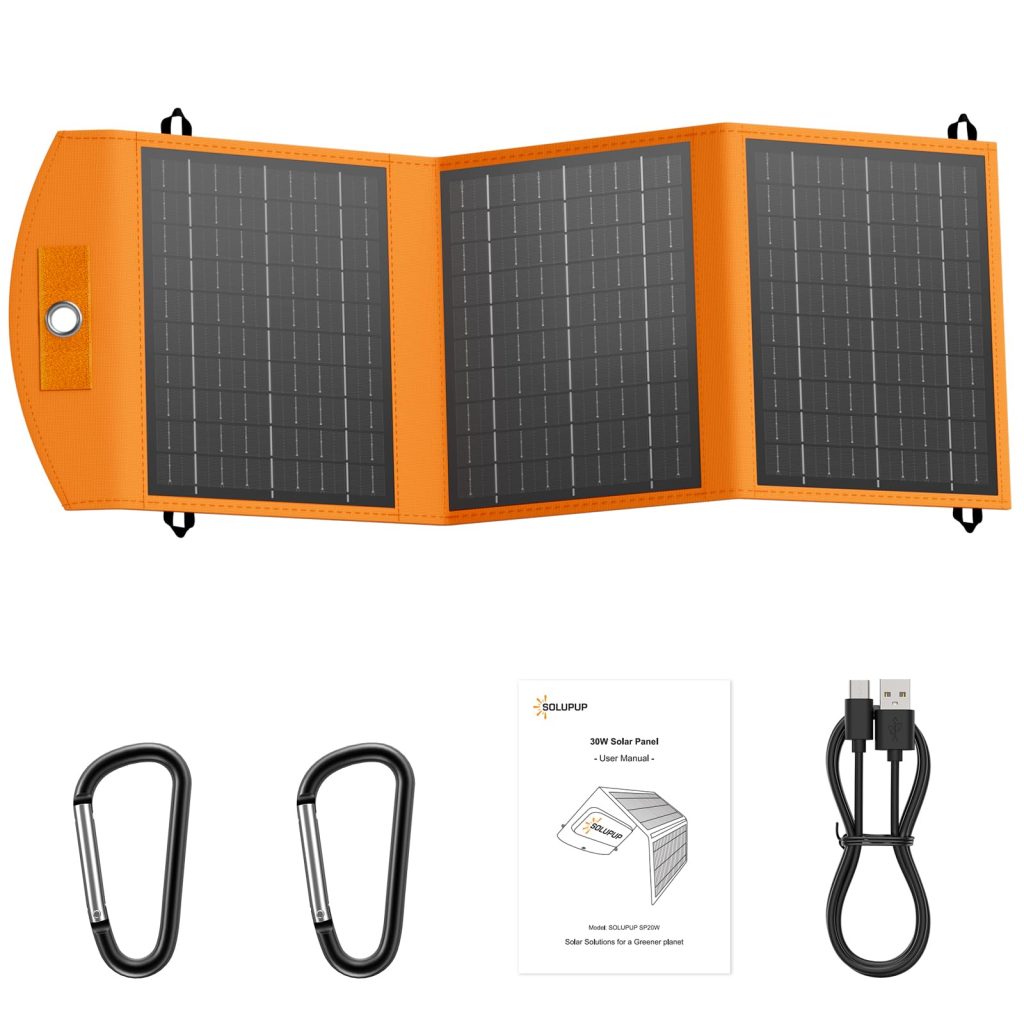
Portable solar chargers occupy an awkward space between convenience and compromise. The 30W foldable model with USB-A and USB-C outputs tries to make the case that you can leave the wall charger at home for short trips, assuming you have reasonable sunlight and realistic expectations. After spending time with similar panels, here’s how this category typically performs and where this specific unit fits.
The design is straightforward: four or five solar panels that fold into a stack roughly the size of a large tablet and unfold to expose the cells. At 30W, it’s in the middle of the portable solar range—more capable than the 10-15W pocket panels but not as bulky as the 60-100W briefcase setups. The USB-A and USB-C ports are built into a small junction box on the panel, and there’s usually a pocket for a power bank or phone. The IPX5 rating means it can handle splashes and light rain, but it’s not meant to be submerged or left out in a downpour.
In real-world use, these panels are most often deployed at campsites, on hiking breaks, or during power outages. You unfold it, angle it toward the sun, and plug in a device. The 30W rating is under ideal conditions—direct overhead sun, cool temperatures, and a device that can accept the full output. In practice, you might see 18-22W on a clear day, less if there’s haze or partial shading. That’s enough to charge a phone in a few hours or top up a power bank over a day. The USB-C port often supports fast charging protocols, but the panel’s output is shared between ports, so charging two devices at once slows both down.
One of the main limitations is that solar charging is inherently slow and weather-dependent. Unlike a wall charger, you can’t just plug in and walk away. You need to reposition the panel as the sun moves, and any cloud cover drops output significantly. Also, the folded size, while portable, is still larger than a compact wall charger, and it weighs a couple of pounds. For a day hike, it might be overkill; for a week-long camping trip, it can be a useful supplement to a power bank.
Compared to a traditional power bank, this solar charger offers the advantage of indefinite power as long as there’s sun, but it’s slower and less reliable. A 20,000mAh power bank can charge a phone four or five times and works anytime, anywhere. The solar panel shines on multi-day trips where you can’t recharge from a wall outlet. It’s also a better fit for emergency kits, where it can sit in a drawer for months and still work when needed.
Who is this for? It’s suitable for campers, hikers, and backpackers who want a lightweight way to keep phones and small electronics topped up during extended trips. It’s also handy for emergency preparedness. Who is it not for? Anyone expecting fast charging or who needs to power laptops or larger devices. If you’re car camping and have access to a vehicle outlet, a power bank or inverter might be more practical. Also, if you mostly stay in hotels or hostels, a wall charger is simpler.
In terms of build quality, the panels are typically laminated with a protective layer, and the corners may have grommets for hanging. The junction box is usually plastic and feels adequate but not rugged. The included cables are often short, so you might need an extension if you want to keep your device in the shade while the panel is in the sun. The IPX5 rating is a plus for outdoor use, but the ports should be kept dry.
Overall, this 30W foldable solar charger is a reasonable option for off-grid charging of small devices. It won’t replace a wall charger for daily use, and its performance is heavily dependent on conditions. But for the right user—someone who spends time outdoors and understands the limitations—it can be a valuable piece of gear. Just don’t expect miracles; solar charging is a slow, steady process.


