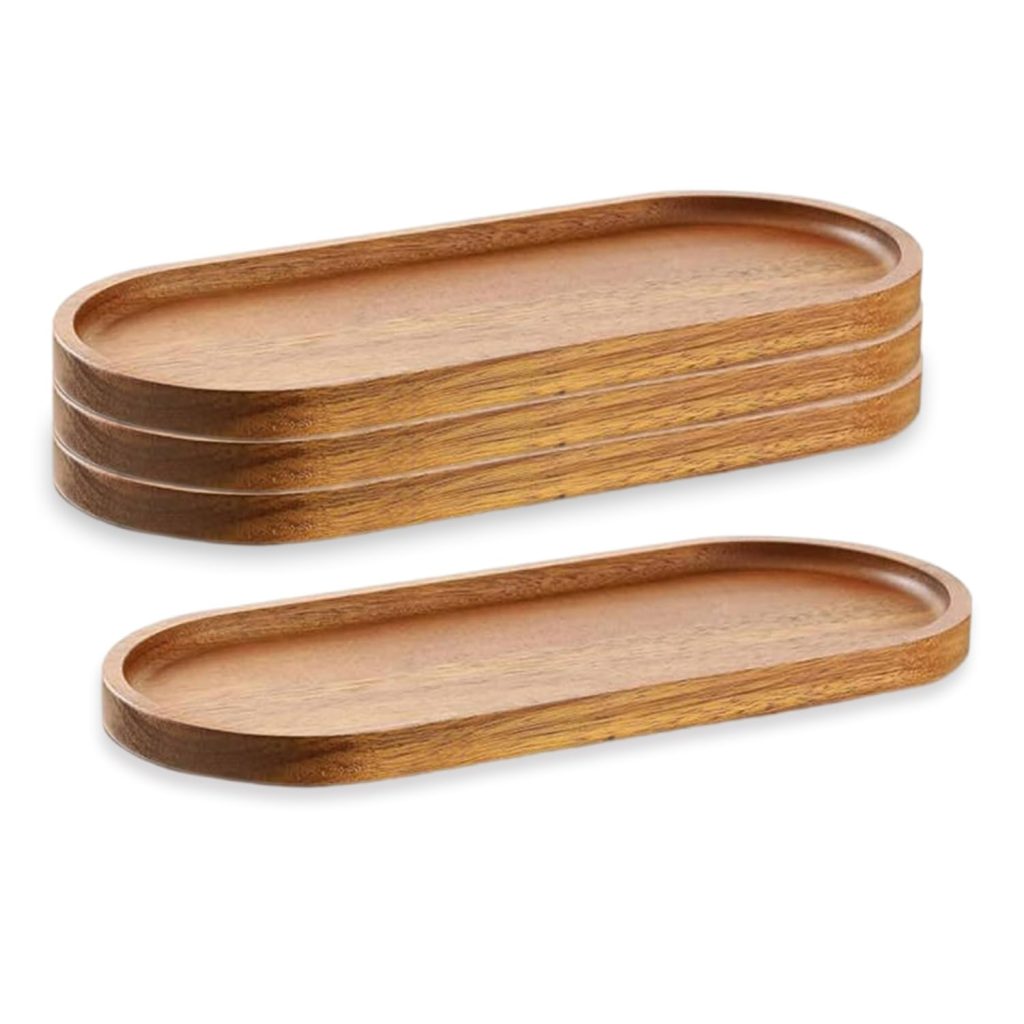
Serving boards tend to fall into two camps: heavy showpieces meant to anchor a table, and light, disposable-feeling trays that do a job and get out of the way. The Linwnil 4-pack of 11.5 x 4 inch oval wooden trays sits firmly in the second camp. These are modest, narrow platters sold in bulk, and understanding what they are — and what they are not — matters more than any single spec.
The dimensions tell most of the story. At 11.5 inches long and 4 inches wide, each tray is closer to a serving plank than a full charcuterie board. That makes them useful for a specific set of tasks: a row of crackers, a handful of olives, sliced bread at a dinner table, or a small appetizer portion per guest. The oval shape gives them a slightly more finished look than a rectangular cutting board, and the narrow footprint means several can sit on a table without crowding it.
Where these trays actually fit
The most realistic use case is entertaining on a budget or at scale. Four matching trays let you set out separate portions of cheese, fruit, nuts, and bread without buying a single large board. They also work well for casual family meals — a tray of sliced fruit for breakfast, a plate for toast, or a serving vessel for snacks during a movie. Because they are small and light, they are easy to pass around, stack, and store. Anyone who has tried to fit a 20-inch charcuterie board into a cabinet knows the appeal of something that tucks away easily.
They are also a reasonable choice for people who host often and want matching serveware without spending much. Buying four trays at once solves the mismatch problem that comes from assembling random plates over time.
Construction and handling
The trays are made of wood, and at this price point the material is best described as serviceable rather than premium. Expect a lightweight build with a visible grain and a smooth-enough surface for dry and semi-dry foods. They are not intended for heavy use or for anything that requires a thick, sturdy cutting surface. These are serving pieces, not prep boards, and treating them as chopping surfaces will shorten their life considerably.
Cleaning is the area where buyers should set expectations. Wooden serveware generally should not go in the dishwasher, and these trays are no exception. Hand washing and prompt drying are the safer routine, and occasional oiling will help them hold up. That extra care is a real trade-off compared with ceramic or melamine platters, which can go straight into the dishwasher. If easy cleanup is a priority, these are not the most convenient option.
Limitations worth knowing
The narrow width is the defining constraint. A 4-inch-wide tray holds a single row of food comfortably; anything more elaborate starts to feel cramped. For a true charcuterie spread with multiple cheeses, cured meats, and accompaniments, one of these trays is too small on its own. Buyers picturing a centerpiece board should look elsewhere, or plan to use several trays together.
The bulk-pack format is also a double-edged sword. Four trays are genuinely useful for a household that entertains, but excessive for someone who needs just one serving piece. There is no option to buy a single tray here, so the value depends entirely on whether the quantity matches your needs.
Finally, the finish quality is likely to be inconsistent at this price. Some units in a pack may have rougher edges or more pronounced grain variation. That is normal for budget wood serveware, but it is worth knowing before ordering.
How they compare
Against ceramic or stoneware platters, these wooden trays are lighter, warmer in appearance, and less likely to chip, but they demand more careful cleaning and offer less rigidity. Against a single large charcuterie board, they trade presentation impact for flexibility and portion control. Against plastic serving trays, they look considerably better on a table, though they require more upkeep. The closest comparison is probably to bamboo serving boards, which share the same care requirements and roughly the same durability expectations.
Who should consider them
- Hosts who want matching, inexpensive serveware for parties and holidays
- Households that serve bread, fruit, cheese, or snacks in small portions regularly
- Anyone short on cabinet space who prefers stackable, narrow trays
- Buyers putting together gift baskets or casual table settings
Who should skip them
- Shoppers looking for a single large charcuterie centerpiece
- People who want dishwasher-safe serveware
- Anyone planning to use the trays for cutting or heavy prep
- Buyers who need only one tray and would rather not store extras
Overall, the Linwnil trays are a practical, low-cost solution for small-portion serving. They are not built to impress or to last for decades, and the hand-wash requirement is a genuine inconvenience. But for casual entertaining and everyday snack service, the size, quantity, and price line up reasonably well — provided you go in expecting a simple wooden tray rather than a premium board.