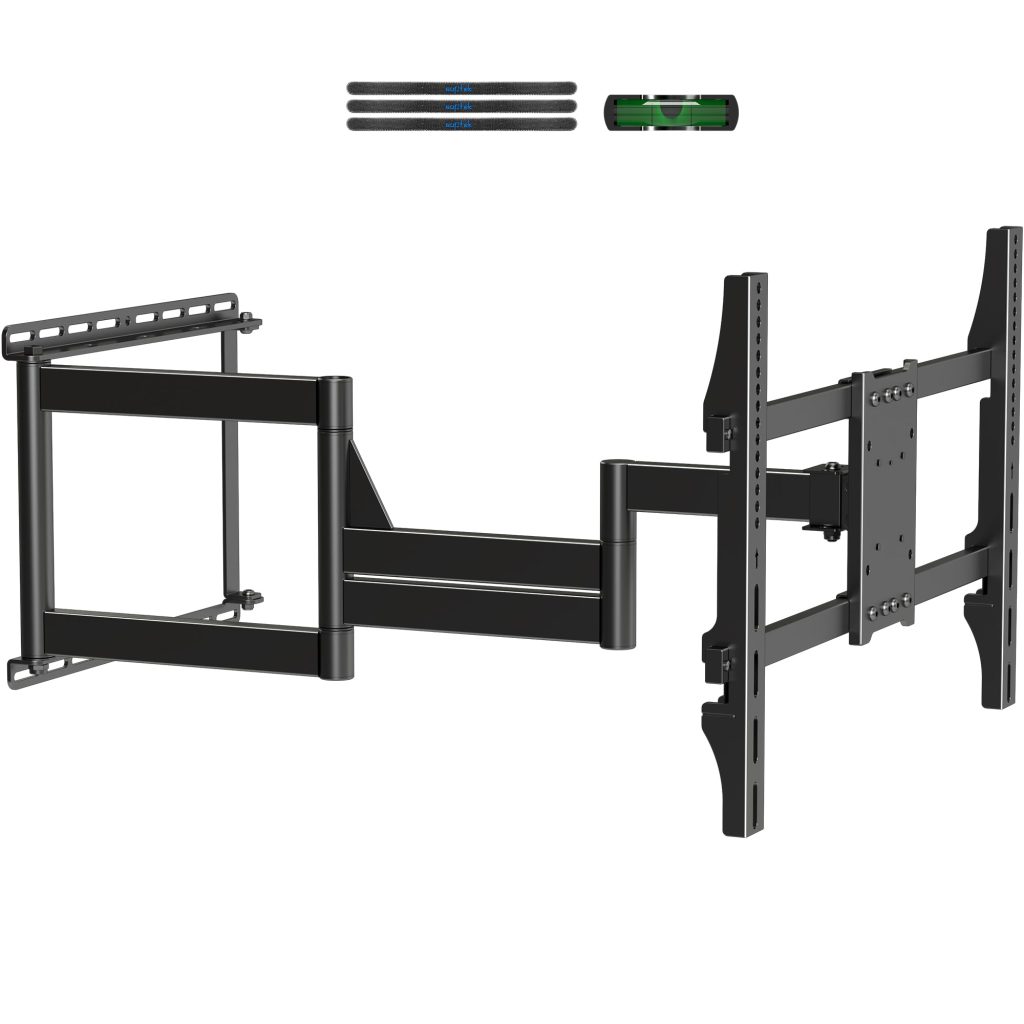
If you’ve ever wished your TV could float across the room, the XINLEI Long Arm TV Wall Mount (model MA1079L) might catch your eye. It’s a full-motion bracket designed for 32- to 84-inch TVs, with a 40-inch extension and a 132-pound weight capacity. But does that long arm make sense for your setup? Here’s a closer look.
What you get
The mount is a single-arm articulating bracket, meaning it can swivel left and right, tilt up and down, and extend outward up to 40 inches from the wall. It supports VESA patterns up to 600x400mm, which covers most large TVs. The arm is made of heavy-gauge steel, and the package includes the necessary hardware for mounting to wood studs up to 16 inches apart. Notably, it does not support metal studs or concrete without additional anchors.
Real-world use
This mount is aimed at rooms where you want flexibility: a living room where seating is off-center, a bedroom where you want to angle the TV toward the bed, or a home gym where you need the screen to face different workout zones. The long extension also helps if you have a corner placement or want to pull the TV out for a better viewing angle without rearranging furniture.
In practice, the 40-inch extension is a lot. It allows the TV to swing far from the wall, but it also introduces leverage. Even with a 132-pound rating, a large TV at full extension will put stress on the wall and the arm itself. You’ll want to make sure the studs are solid and the lag bolts are tightened properly. Some users might find that the arm sags slightly when fully extended, especially with heavier TVs near the upper limit. That’s a common trade-off with long-arm mounts.
Key features and specs
- Extension: Up to 40 inches from the wall.
- Swivel: Up to 180 degrees (depending on TV size and wall clearance).
- Tilt: +5 to -15 degrees, which helps reduce glare.
- Weight capacity: 132 pounds.
- VESA compatibility: Up to 600x400mm.
- Mounting: Wood studs up to 16 inches apart (no concrete or metal stud support without extra hardware).
Where it falls short
The biggest limitation is the single-arm design. Dual-arm mounts tend to be more stable and distribute weight better, especially for larger TVs. With this XINLEI, you may notice some wobble when you adjust the TV or if someone bumps it. Also, the tilt range is modest; if you need steep downward angles, this might not be enough.
Installation is not a one-person job for a big TV. The arm is heavy, and aligning the brackets while holding the TV is tricky. The instructions are adequate but not exceptional. You’ll need a stud finder, a drill, and a level. And because the arm extends so far, you’ll need to consider the wall’s strength—if you have drywall with flimsy studs, this might not be the best choice.
How it compares
Compared to a standard fixed or tilting wall mount, this XINLEI offers far more flexibility but at the cost of stability and a higher price. Fixed mounts are cheaper, simpler, and keep the TV flush to the wall. Full-motion mounts with shorter arms (say, 15-20 inches) are a middle ground: they allow some angling without the leverage issues of a 40-inch arm. If you don’t need to pull the TV out that far, a shorter arm might be a better fit.
Who should consider it
This mount is a good option if you need to position your TV at a significant angle or distance from the wall, and you have a solid wood-stud wall. It’s suitable for renters? No—landlords usually frown on big holes. It’s for homeowners or DIYers who can install it securely. It’s also not ideal for TVs over 75 inches or those near the 132-pound limit, because the arm may not feel sturdy enough. For a 55- to 65-inch TV, it’s more manageable.
If you have a smaller TV (under 50 inches) or don’t need the long extension, you can save money and get a more stable mount with a shorter arm. Similarly, if you want a flush look, a fixed mount is better.
Final thoughts
The XINLEI MA1079L is a functional long-arm mount that does what it claims, but it’s not without compromises. The 40-inch extension is impressive, but it demands a solid installation and a TV that isn’t too heavy. The single-arm design is a weakness for larger screens. If your setup requires that kind of reach, this could work well. If not, a shorter-arm or dual-arm mount might be a wiser choice. It’s a niche product that solves a specific problem, and for that, it’s worth considering—just go in with realistic expectations.


