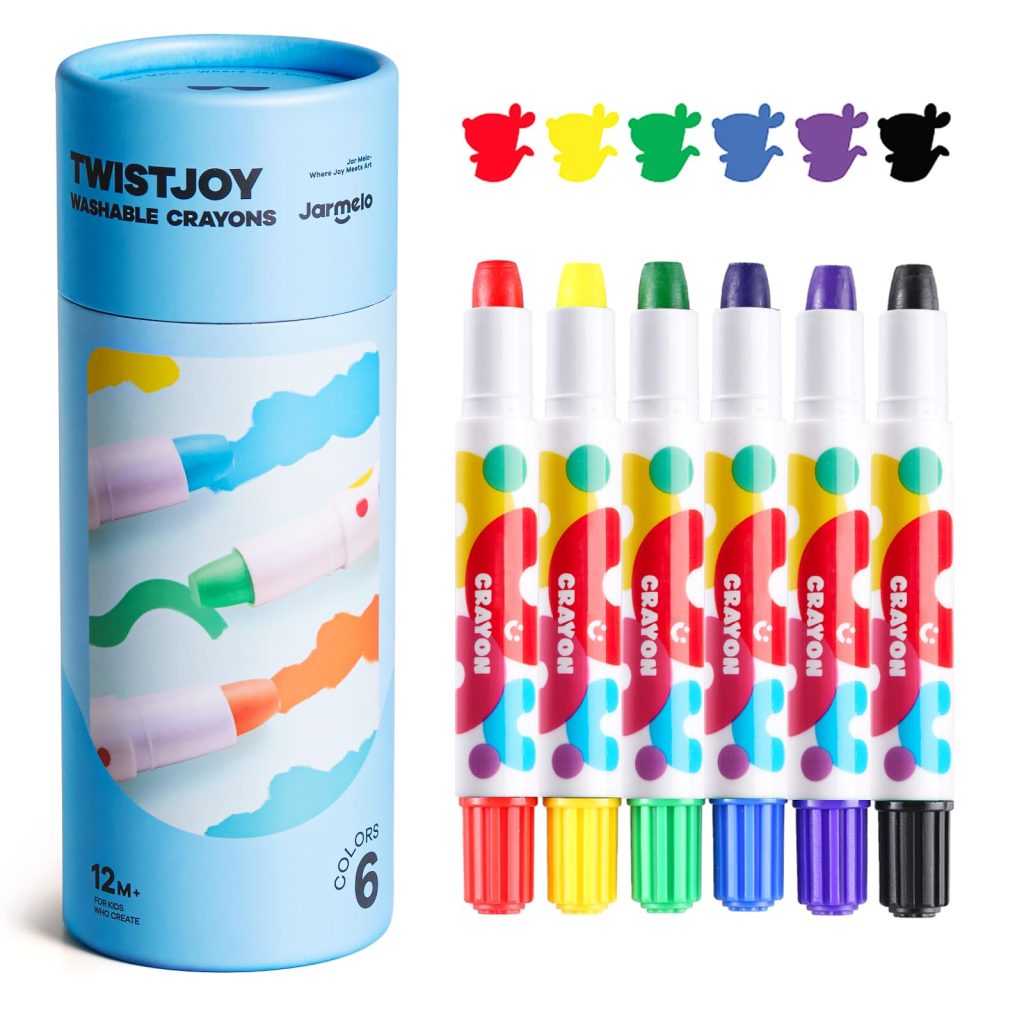
Toddler art supplies tend to fall into two camps: cheap crayons that snap the moment a child leans on them, and elaborate sets that cost more than most parents want to spend on something destined for the floor. The Jar Melo Jumbo TwistJoy crayons sit somewhere in the middle. The set includes six colors in a chunky twist-up format, marketed as washable and sized for small hands. Whether that combination holds up in daily use is worth examining, because the twist mechanism and the jumbo barrel each solve a problem while introducing a different one.
The first thing to understand about this product is how it is actually used. These are not crayons you sharpen or peel. Each one is a thick plastic barrel with a twist dial at the base that advances the crayon tip as it wears down. In practice, that means a toddler can hold the barrel like a stubby marker, press down with a full fist grip, and the crayon does not collapse. For families with children in the roughly 18-month to three-year range, that is a meaningful difference from standard crayons, which tend to break under exactly that kind of pressure. The barrels are wide enough that a child who has not yet developed a pincer grip can still manipulate them, and the twist action is simple enough that most toddlers figure it out within a session or two, sometimes to the point of over-twisting.
Functionally, the set covers the basics. Six colors is a modest palette, but it is enough for scribbling, color identification, and early drawing without overwhelming a young child with choices. The crayon material is described as washable, and in normal use that claim holds reasonably well on skin and most fabrics, though washability is always a matter of how quickly a mark is addressed and what surface it lands on. Crayon on painted walls or upholstery is a different proposition from crayon on a cotton shirt, and no washable crayon should be treated as fully stain-proof. The twist mechanism also means the crayon is never fully exposed, which reduces the chance of it being snapped in half or eaten down to a nub in one sitting.
The trade-offs are real, though. The plastic barrel design means these crayons are bulkier than traditional wax crayons, and some children who are used to the feel of bare wax resist the format at first. More significantly, the twist mechanism introduces a failure point that plain crayons do not have. Toddlers who twist the dial past the point of resistance can wind the crayon back into the barrel or, in some cases, cause the internal advance mechanism to jam. Once a TwistJoy crayon jams, it is generally not repairable, and that barrel is effectively done. This is not a hypothetical concern; it is the most common long-term complaint with twist crayons as a category, and it is worth factoring in if the child in question is in a determined dismantling phase.
The color payoff is also worth setting expectations around. These are toddler crayons, and the wax is formulated to be soft and easy to lay down, which means lines are bold but also prone to smudging, particularly on glossy paper. The tips are rounded rather than pointed, which is safer for young children but limits detail work. A child moving toward drawing recognizable shapes and filling in coloring books will likely find the jumbo tip imprecise. At that stage, a set of standard triangular grip crayons or short, thick beginner crayons often serves better, since they offer more control and are cheaper to replace when they break.
Compared with ordinary jumbo crayons, the main advantage here is the barrel: no paper to peel, no wax on fingers, and less breakage. Compared with washable markers, crayons are generally more forgiving on paper and less likely to bleed through, though markers offer more vivid color and finer lines. Families often end up with both, using crayons for free scribbling and markers for supervised table work.
As for who this suits: it fits households with children roughly 18 months to three years old who are still developing grip strength and who tend to press hard or drop things. It also works for travel and restaurant situations, since the enclosed barrel keeps wax off surfaces and the crayons are less messy to pack than loose wax. It is not a good fit for older preschoolers who want precision, for children who compulsively twist and dismantle things, or for parents looking for a long-lasting art supply, because the mechanism, not the wax, tends to determine the product’s lifespan. Treated as a transitional tool for the earliest drawing years, the TwistJoy set does its job; treated as a durable long-term crayon, it will likely disappoint.