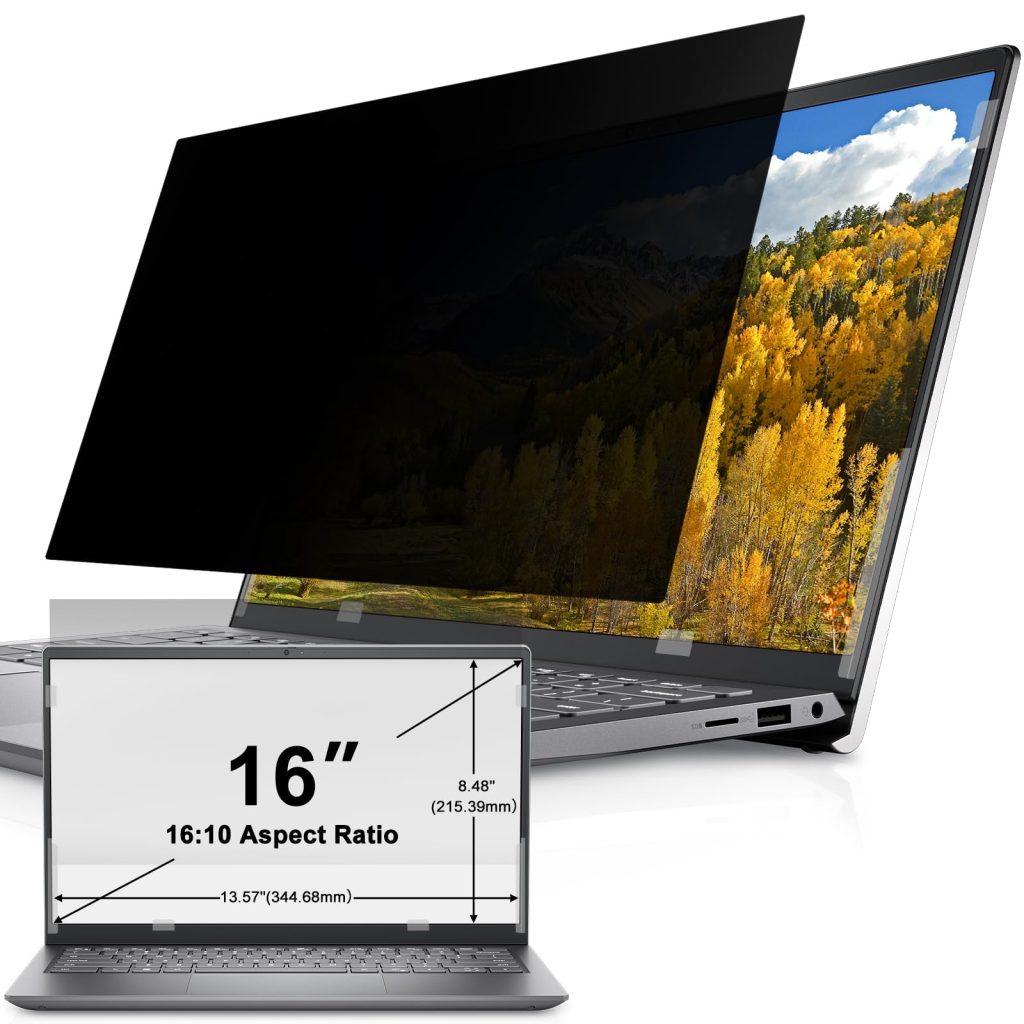
If you work in an open office, on a train, or in a coffee shop, you’ve probably felt the unease of having your screen visible to anyone walking by. The IPROKKO Laptop Privacy Screen for 16-inch laptops with a 16:10 aspect ratio aims to solve that by limiting the viewing angle of your display. It’s a simple concept: a thin plastic filter that attaches to your screen and darkens it when viewed from the side. But how well does it work in practice, and what are the trade-offs? I spent some time researching user experiences and examining the product details to give you a realistic picture.
The IPROKKO privacy screen is designed specifically for 16-inch laptops with a 16:10 aspect ratio—a size that’s become more common with models like the MacBook Pro 16, Dell XPS 16, and various gaming laptops. The filter itself is a rigid plastic panel that you place over your screen. It doesn’t adhere with adhesive; instead, it relies on tiny tabs that you attach to the top of your laptop bezel. These tabs hold the filter in place, and you can easily remove it when you don’t need privacy. That’s a thoughtful design for people who want to switch between privacy and sharing their screen quickly.
In terms of functionality, the privacy effect is achieved through a micro-louver technology that restricts the viewing angle. From straight on, the screen remains visible, though with a slight dimming—typically around 20-30% darker than without the filter. Move just a few degrees to the side, and the screen becomes increasingly obscured, turning nearly black at angles beyond 30 degrees. This is effective for blocking shoulder surfers, but it also means that if you’re collaborating with someone sitting next to you, they won’t be able to see your screen clearly. That’s a limitation to keep in mind: privacy screens are inherently antisocial for in-person collaboration.
One of the key features of this IPROKKO model is that it’s reversible. One side has a matte finish to reduce glare, while the other is glossy for sharper clarity. You can choose the side that suits your environment. The matte side does a decent job of cutting reflections, which is helpful under bright office lights, but it can make the image look slightly grainy. The glossy side offers better contrast but reflects more light. It’s a trade-off, and you’ll likely find yourself preferring one over the other depending on where you work.
Installation is straightforward but not without quirks. The tabs that hold the screen are small plastic pieces that you stick to your laptop’s bezel. They’re low-profile, but they do add a slight bump. If you frequently close your laptop and slide it into a sleeve, you might worry about the tabs catching or the filter shifting. Also, the filter doesn’t attach magnetically like some higher-end options, so it can feel a bit less secure. However, for the price, it’s a reasonable compromise.
Another consideration is the impact on touchscreen laptops. If your 16-inch laptop has a touchscreen, you’ll need to remove the filter to use touch input, as it’s not designed to be touched. That’s a hassle if you rely on touch. Additionally, the filter adds a bit of thickness, so your laptop may not close completely flush if you leave it on. Most users report that it’s fine, but it’s something to check.
How does it compare to alternative solutions? There are software-based privacy filters that darken the screen when you’re not looking, but they’re not as secure—they don’t prevent someone from taking a photo of your screen. There are also privacy screens that use polarized film, which can be more expensive but offer a clearer view from the front. The IPROKKO sits in the middle: it’s more affordable than premium brands like 3M, but it may not have the same optical clarity. If you’re on a tight budget, it’s a viable option, but if you need the best possible image quality, you might want to invest more.
Who is this for? It’s ideal for professionals who handle sensitive information in public spaces—think HR, finance, healthcare, or legal. It’s also useful for students in libraries or anyone who values their privacy on the go. However, it’s not for creative professionals who need color accuracy; the filter does alter colors slightly, and the dimming can affect photo or video editing. It’s also not for those who frequently collaborate with others around their laptop, as the narrow viewing angle makes it hard for others to see. And if you have a touchscreen, you’ll likely find it annoying.
In terms of build quality, the IPROKKO screen is made of plastic, so it’s prone to scratching if not handled carefully. It comes with a cleaning cloth and a protective sleeve, which is a nice touch. But over time, you might notice minor scratches that can affect clarity. It’s not a forever product, but with proper care, it should last a while.
Overall, the IPROKKO Laptop Privacy Screen is a functional, no-frills solution for adding a layer of privacy to your 16-inch laptop. It does what it claims, but with the usual caveats of privacy filters: reduced brightness, narrow viewing angles, and some installation fuss. If you need privacy on a budget, it’s worth considering. If you demand the highest optical quality or need to share your screen often, you might want to look elsewhere.


