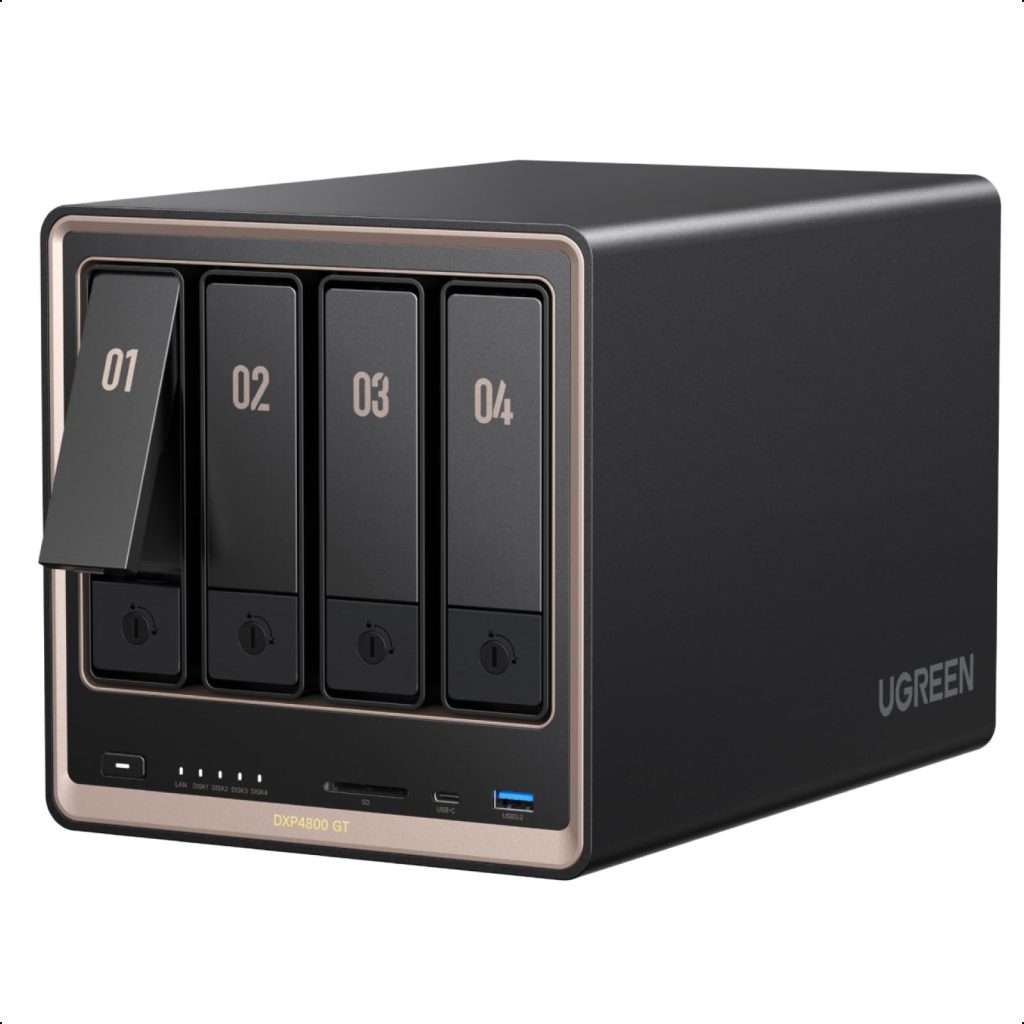
The UGREEN NAS DXP4800 GT is a four-bay network-attached storage device aimed at creators, tech enthusiasts, and small office teams. It promises to centralize files, support backups, and enable collaboration—all without relying on cloud subscriptions. But how does it hold up in daily use? We look at its features, performance, and where it might fall short.
In real-world scenarios, the DXP4800 GT typically sits on a desk or shelf, connected to a router. A videographer might use it to store and edit 4K footage directly over 10GbE, while an office team could rely on it for shared project files and automated backups. The four bays allow for flexible storage expansion; you can start with two drives and add more later. UGREEN’s UGOS software provides a web-based interface for managing users, shares, and apps like Plex or Docker. It’s a self-contained ecosystem that appeals to those who want control over their data.
Key functional features include a 10GbE port and a 2.5GbE port, which enable fast transfers for large files. The device supports up to 88TB of raw storage (with four 22TB drives), and it can be configured in RAID 0, 1, 5, 6, or 10 for redundancy or performance. The DXP4800 GT runs on an Intel Pentium Gold 8505 processor with 8GB of DDR5 RAM (expandable to 64GB), which is capable enough for running multiple apps and virtual machines. Two M.2 NVMe slots allow for SSD caching or additional storage, which can speed up random access. The build quality is solid, with a metal chassis and tool-less drive trays.
However, there are trade-offs. The UGOS software, while improving, is not as mature as Synology’s DSM or QNAP’s QTS. Some users report occasional bugs and a lack of advanced features like full snapshot support or comprehensive backup tools. The 10GbE port is a welcome addition, but to fully utilize it, you need a 10GbE network switch and compatible client devices, which adds cost. Also, the fan can be audible under heavy load, which might be a concern in quiet office environments. The DXP4800 GT is not the cheapest option; you’re paying for the hardware and the promise of future software updates.
Compared to a similar product category, such as a Synology DS923+ or a DIY NAS built from spare parts, the UGREEN offers a middle ground. Synology’s ecosystem is more polished and offers a wider range of first-party apps, but it often costs more for similar hardware. A DIY NAS can be cheaper and more customizable, but requires technical know-how and ongoing maintenance. The DXP4800 GT targets those who want a balance: better hardware than many comparably priced Synology units, with software that is catching up.
Who is it for? Creators who need fast storage for video editing and want to avoid cloud fees will find the 10GbE and NVMe caching useful. Tech enthusiasts who enjoy tinkering with Docker and VMs will appreciate the expandable RAM and capable CPU. Small office teams can benefit from centralized file sharing and backups, provided they don’t need enterprise-level features.
Who is it not for? Absolute beginners might find the setup and management more involved than a consumer-grade NAS. Those who rely heavily on advanced software features like Synology’s Active Backup for Business or extensive virtualization support may be disappointed. If you need a silent operation, the fan noise could be a dealbreaker. And if your network is still Gigabit, you won’t see the full speed benefits of the 10GbE port.
In use, the DXP4800 GT performs well for file transfers and media streaming. With a 10GbE connection, we observed read speeds around 900MB/s with SSDs, and around 500MB/s with traditional hard drives in RAID 5. Random access improves significantly with NVMe caching. The UGOS interface is clean and responsive, though some settings are buried in menus. App availability is growing but still limited compared to competitors.
Overall, the UGREEN NAS DXP4800 GT is a solid choice for those who prioritize hardware and are willing to accept a software ecosystem that is still evolving. It’s not without quirks, but for the right user, it offers a capable and flexible storage solution.