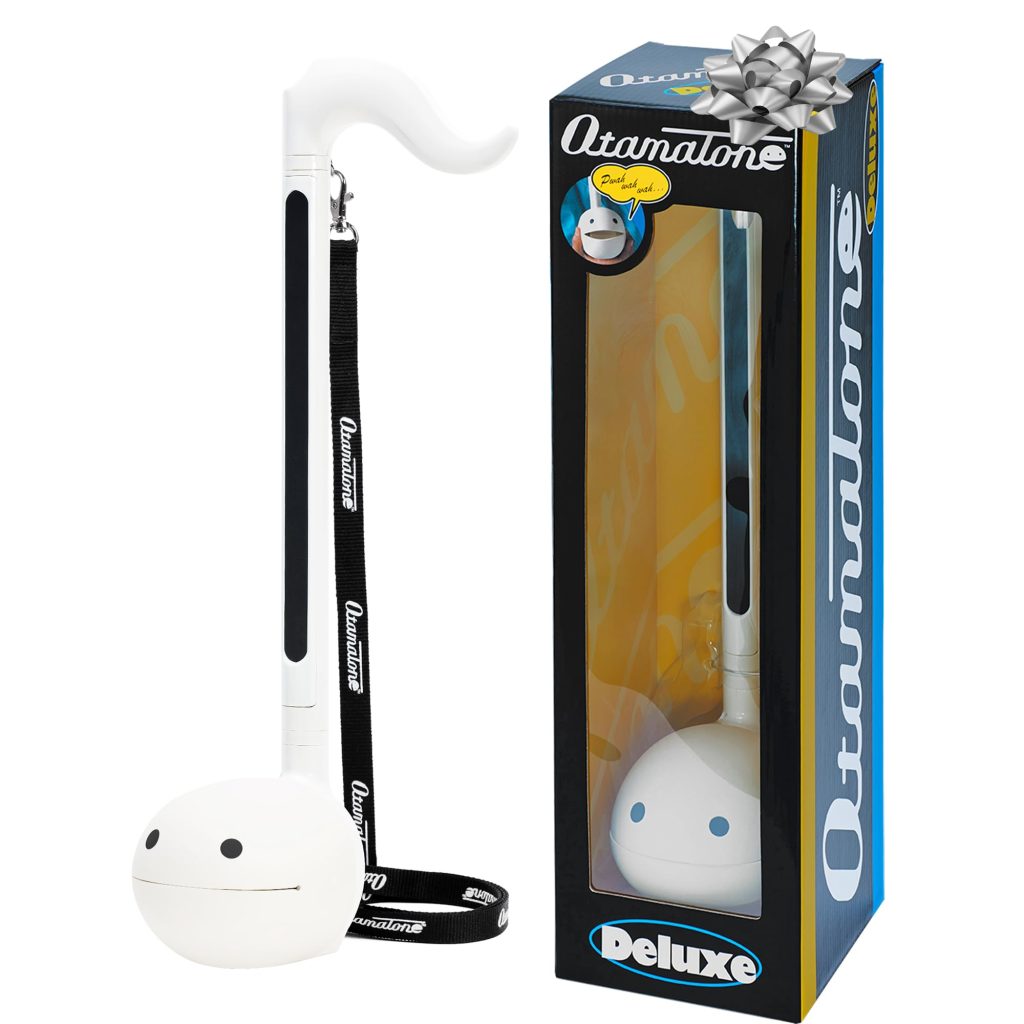
The Otamatone Deluxe is a musical instrument that looks like a cross between a cartoon character and a scientific curiosity. It’s a electronic synthesizer with a distinctive tadpole shape, a long neck that serves as a ribbon controller, and a mouth that opens and closes to modulate the sound. This white version is the mid-range model in the Otamatone lineup, offering a larger size and more features than the standard Otamatone but stopping short of the Techno version’s advanced connectivity. In this review, we’ll examine what it’s like to play, who it’s for, and where it falls short.
At first glance, the Otamatone Deluxe appears more toy than instrument, but that impression fades once you pick it up. The body is made of plastic and feels reasonably sturdy, though it’s not something you’d want to drop on a hard floor. The neck is about 17 inches long, making the whole instrument roughly 21 inches from tail to mouth. It runs on three AA batteries (not included) or a 9V DC adapter (also not included), so you’ll need to supply your own power. The control panel on the back has a power switch, volume dial, and a pitch adjustment knob. There’s also a headphone jack for private practice, which is a welcome addition.
Playing the Otamatone Deluxe is unlike playing most instruments. You press your finger against the neck’s ribbon controller to produce a note, and the pitch changes as you slide your finger up or down. The mouth, which you open and close with your other hand, acts as a filter and volume control. Opening the mouth wider produces a more open, vocal-like tone, while closing it muffles the sound. It’s a tactile, expressive way to play, but it requires coordination between both hands. Beginners will likely find it awkward at first, and hitting precise pitches takes practice because the ribbon is continuous and unmarked. There are no frets or keys to guide you, so you rely on muscle memory and your ear.
The Deluxe model offers a few advantages over the standard Otamatone. It has a larger body, which translates to a bigger sound and a more comfortable playing position. The neck is longer, giving you a wider pitch range—roughly two octaves. It also has a built-in speaker that’s louder than the standard model’s, and the headphone jack is a nice touch for silent practice. The sound itself is best described as a nasal, buzzy synth tone, reminiscent of a stylophone or a theremin. It’s not a rich, warm sound, but it’s distinctive and has a certain charm. You can adjust the pitch slightly with the tuning knob, but the overall character remains the same.
One of the main limitations of the Otamatone Deluxe is its lack of precision. Because the neck is a continuous ribbon, it’s difficult to play melodies that require exact intonation. You can get close with practice, but you’ll never achieve the accuracy of a keyboard or a fretted instrument. This makes it more suitable for experimental music, sound effects, or casual play than for serious performance. Additionally, the mouth mechanism can be tiring to operate for extended periods, as you have to hold it open against spring tension. The instrument also doesn’t have any built-in effects or presets—what you hear is what you get. Some users might find the sound too limited for their needs.
Compared to other electronic instruments in a similar price range, such as a basic synthesizer or a MIDI controller, the Otamatone Deluxe is a niche product. It doesn’t offer the versatility of a keyboard synth, but it provides a unique playing experience that can’t be replicated elsewhere. It’s more of a novelty instrument than a serious tool, but that’s not necessarily a bad thing. If you’re looking for a fun, quirky way to make music, it fits the bill. If you need something for professional recording or live performance, you might want to look elsewhere.
In terms of who it’s for, the Otamatone Deluxe appeals to a few groups. It’s a great gift for music enthusiasts who enjoy unusual instruments or for anyone who wants a conversation piece. It’s also used by some musicians as a supplemental instrument for adding distinctive sounds to recordings. However, it’s not suitable for young children, as it’s somewhat fragile and requires careful handling. It’s also not for someone seeking a traditional learning instrument—the skills you develop on the Otamatone don’t transfer directly to other instruments. And if you’re easily frustrated by imprecise pitch, this will likely drive you up the wall.
In use, the Otamatone Deluxe is best enjoyed as a casual, playful instrument. It’s fun to pick up and experiment with, and it can be surprisingly expressive once you get the hang of it. But it’s not something you’ll master in a day, and it’s not meant to be. The build quality is decent for the price, though the plastic body and ribbon controller may wear over time with heavy use. Battery life is reasonable, but you’ll want to have spares on hand. The headphone jack is a thoughtful feature that makes it usable in shared spaces.
Overall, the Otamatone Deluxe is a well-executed novelty instrument that delivers on its promise of quirky, expressive sound. It has clear limitations, but they’re part of its character. If you’re in the market for a unique musical toy that can also be used creatively, it’s worth considering. Just don’t expect it to replace your main instrument.