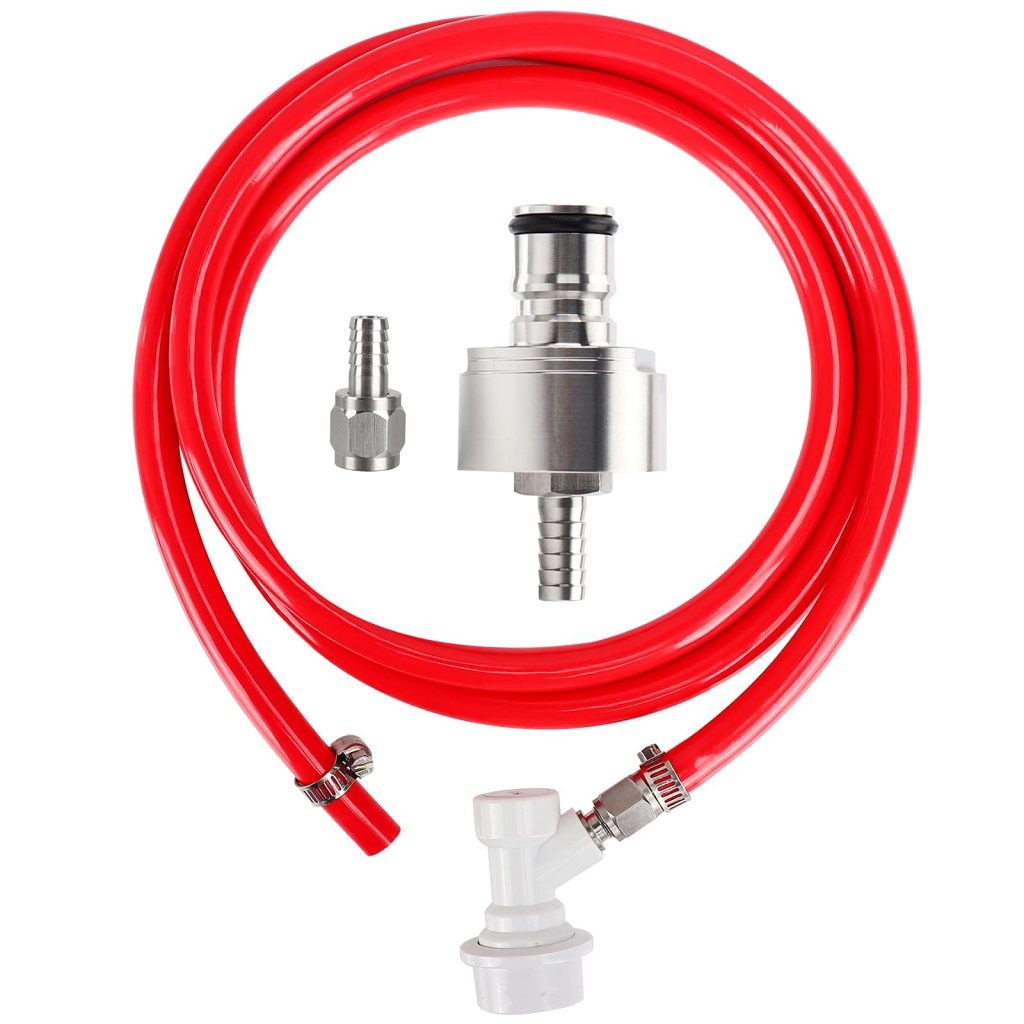
Setting up a home kegerator or a soda bottle carbonation rig often involves piecing together components from different suppliers. The Hgkeke 5.5ft 5/16 Co2 Gas Line Tubing kit aims to simplify that process by bundling a red hose, a stainless steel carbonator cap, and a ball gas lock into one package. After testing this kit with a standard 2-liter soda bottle and a small CO2 tank, here is how it actually performs in a typical homebrew or DIY soda setup.
The centerpiece of this kit is the 5.5-foot length of 5/16-inch inner diameter gas line. This size is fairly standard for many home draft systems, so it should fit most ball lock posts and regulators without much fuss. The tubing is made of flexible PVC, which feels sturdy enough for low-pressure carbonation tasks—think around 10 to 30 PSI. It does not kink easily when bent around tight corners inside a kegerator, though it is not as supple as some silicone alternatives. The red color is purely cosmetic but helps differentiate gas lines from beer lines in a multi-tap setup.
Key functional features include the stainless steel carbonator cap, which threads onto standard PET soda bottles. The cap includes a small barbed fitting that connects to the gas line. Stainless steel is a sensible choice here because it resists corrosion from CO2 and moisture better than plated brass might over time. The ball gas lock (also called a ball lock gas disconnect) snaps onto a cornelius keg post or a carbonator cap with a satisfying click. It is a standard design, so replacement parts are easy to find if needed. The kit also comes with a small hose clamp to secure the tubing to the barb.
In real-world usage, this kit works well for carbonating water or beer in a 2-liter bottle. Attach the carbonator cap, connect the gas line to your CO2 tank, and set the regulator to around 20 PSI. Shake the bottle gently for a minute, then let it sit for a few hours. The result is decently carbonated soda or seltzer, though the carbonation level depends heavily on your patience and the temperature of the liquid. Colder liquids absorb CO2 more efficiently, so keep that in mind. For keg-based systems, the ball lock gas disconnect is compatible with most homebrew kegs, but the tubing length is relatively short at 5.5 feet. That might be fine for a small kegerator, but if your CO2 tank sits far from the keg, you may need an extension.
A limitation worth noting is the hose material itself. While PVC is functional, it can impart a slight plastic taste to the gas if the line is brand new. A quick rinse or a short flush with CO2 before first use helps reduce this. Over time, the taste fades, but it is not as neutral as high-end EVA barrier tubing used in some draft systems. Additionally, the hose clamp included is a basic worm-drive type, which can dig into the tubing if overtightened. A more gentle oetiker clamp would be ideal, but the included one works if you are careful.
Compared to buying a generic carbonator cap and gas line separately from a homebrew shop, this kit offers convenience and a slightly lower total cost. However, if you need a longer hose or a different connector type (like a pin lock for older kegs), you would be better off sourcing individual parts. This kit is specifically geared toward ball lock systems and standard soda bottles. For beer enthusiasts using cornelius kegs with ball lock posts, it is a straightforward addition. For those with pin lock kegs or commercial soda tanks, it will not fit without adapters.
Who is this suitable for? Homebrewers who want a simple way to carbonate soda or force carbonate beer in a bottle without investing in a full keg setup. It is also handy for anyone building a small kegerator from scratch and needing a basic gas line. Who might want to skip it? If you already own a carbonation cap or have a draft system with specialized gas lines (like 3/16-inch ID for low-pressure applications), this kit may be redundant. Also, if you need a longer hose for a larger kegerator, look for a 10-foot or 15-foot option instead.
Overall, the Hgkeke kit does what it promises: it provides the essentials to connect a CO2 source to a soda bottle or keg. It is not a premium product, but it is functional and reasonably priced. Just be aware of the short hose length and the slight plastic taste during initial use. For a casual home carbonation setup, it gets the job done without fuss.