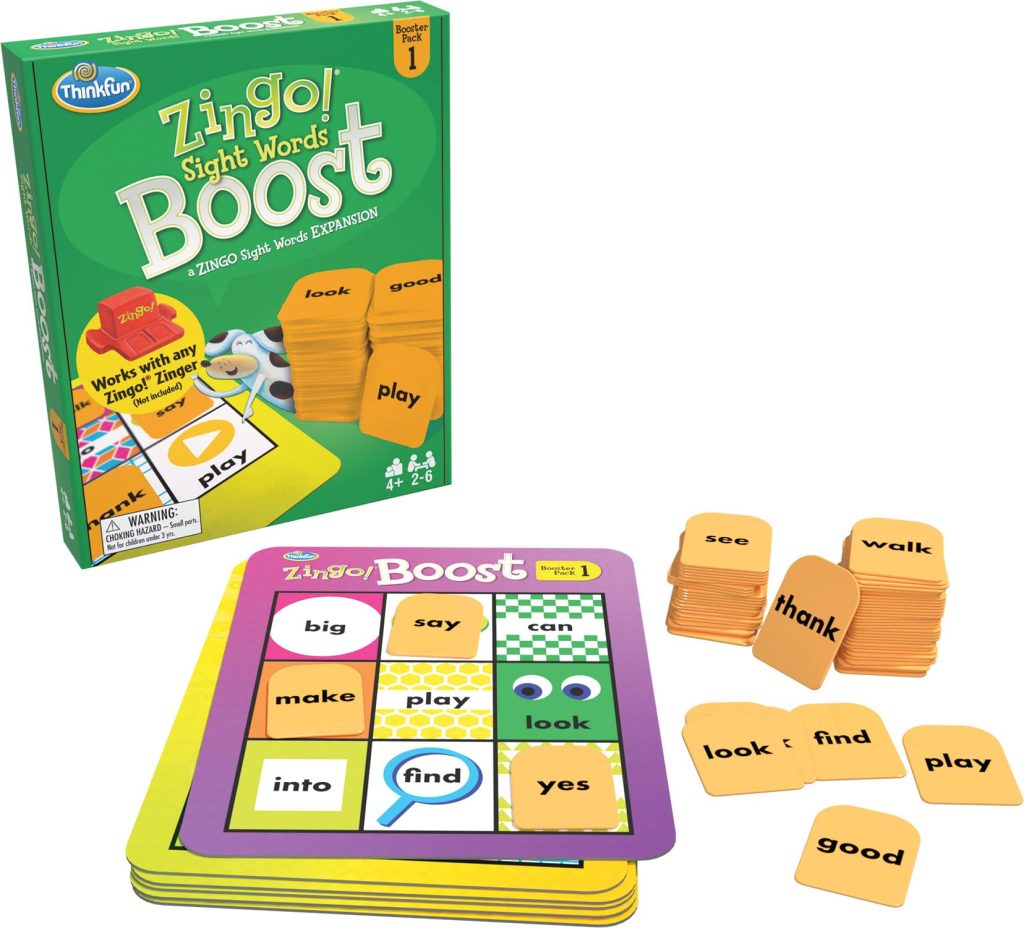
ThinkFun’s Zingo! Sight Words Boost is an expansion pack for the original Zingo! Sight Words game, adding 72 new sight words to the mix. It’s designed for children aged 4 and up, aiming to build vocabulary and reinforce memory and concentration through a bingo-style game. But does it deliver? Here’s a closer look.
The game follows the same mechanics as the base Zingo! Sight Words: players use a Zingo! Zinger device to dispense tiles with words on them, and they must match those words to their bingo-style cards. The Boost pack introduces a new set of words, presumably more challenging than the original set, to help children progress. It’s a straightforward concept that leverages the appeal of a mechanical dispenser and the familiarity of bingo.
In practice, Zingo! Sight Words Boost is used as a supplemental learning tool. Parents or educators pull it out for short play sessions, often with one to four children. The Zinger adds a tactile element that keeps kids engaged, and the competitive aspect encourages them to recognize words quickly. It’s not a standalone game—you need the original Zingo! Sight Words to play, since the Boost pack only includes new tiles and cards, not the Zinger itself. That’s a key point to note if you’re considering this as a gift.
The components are typical of ThinkFun: sturdy cardboard tiles and cards, and a plastic Zinger that holds up to repeated use. The tiles are double-sided, with a word on one side and a corresponding image on the other, which helps with word-picture association. The cards are colorful and feature a grid of words. The Boost pack includes six double-sided cards and 72 tiles, expanding the word bank significantly. The words are common sight words like “because,” “laugh,” and “together,” which are often taught in early elementary grades.
One of the strengths of this expansion is that it extends the life of the base game. If your child has mastered the original words, the Boost pack provides a fresh challenge without requiring a whole new game. It’s also a good way to differentiate instruction if you’re playing with children at different reading levels—you can mix tiles from both sets to adjust difficulty.
However, there are limitations. First, the reliance on the original game means it’s not a complete product on its own. If you don’t already own Zingo! Sight Words, you’ll need to buy both, which increases the cost. Second, the Zinger mechanism, while fun, can be a source of frustration if tiles jam or if multiple players want to use it simultaneously. It’s also relatively loud, which might be a consideration in a classroom setting. Third, the game is designed for a specific skill—sight word recognition—so it’s not a comprehensive reading curriculum. It’s a supplement, not a replacement for structured phonics instruction.
Compared to other sight word games, such as flashcards or digital apps, Zingo! offers a more interactive, screen-free experience. Flashcard drills can be tedious, and apps, while engaging, often lack the social interaction of a tabletop game. Zingo! strikes a balance by making repetition fun, but it may not appeal to children who prefer solo activities or who are already reading fluently. It’s best suited for emergent readers who are just starting to recognize common words.
In terms of age range, the 4+ rating seems appropriate, though some 4-year-olds might find the words challenging without adult support. The game is more likely to hit the sweet spot for 5- to 7-year-olds. Older children who have moved beyond sight words will likely find it too easy, even with the Boost pack. As with any educational game, adult involvement can enhance the learning, but the game is designed for independent play once children understand the rules.
Overall, Zingo! Sight Words Boost is a solid expansion that adds value for families who already enjoy the base game. It’s not without flaws—the dependence on the original set and the occasional Zinger hiccups are worth noting—but for its intended purpose, it works. It provides a playful way to reinforce sight word recognition, and the added words offer a meaningful step up in difficulty. If you’re looking for a screen-free activity that supports early literacy, this is a reasonable option, provided you already have the starter set.