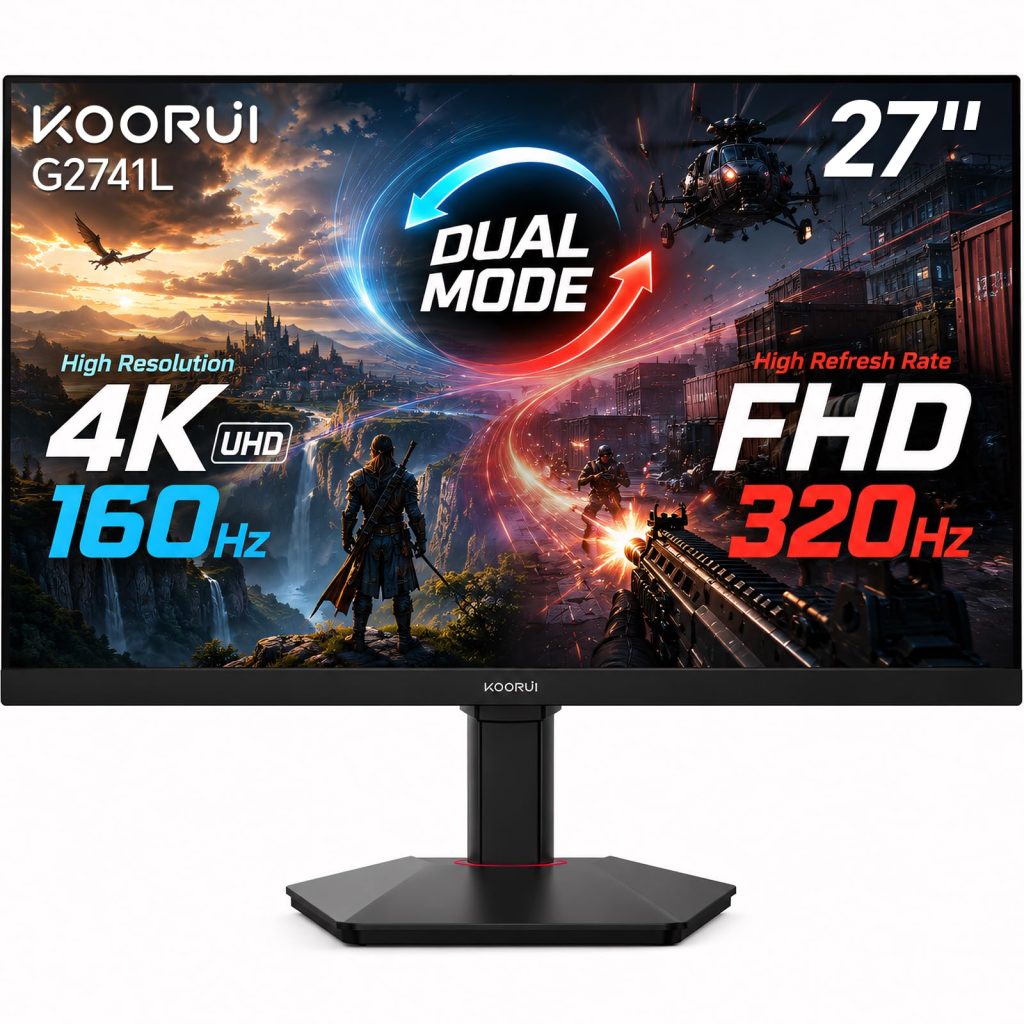
The KOORUI G2741L enters the increasingly crowded 27-inch 4K gaming monitor market with a notable party trick: a dual-mode feature that lets you switch between UHD at 160Hz and FHD at 320Hz. It’s an intriguing proposition for gamers who want both high-resolution immersion and extreme frame rates, but does it deliver in practice? After spending time with this monitor across various games and desktop tasks, here’s what stood out.
Out of the box, the build quality feels solid for its price tier. The stand offers height, pivot, and tilt adjustments, which is a welcome inclusion—many monitors in this range skimp on ergonomics. The bezels are reasonably slim, and the overall aesthetic is understated, leaning more toward functional than flashy. Connectivity is generous: two HDMI 2.1 ports (one supporting 4K at 144Hz, the other at 120Hz), a DisplayPort 1.4 (good for full 4K 160Hz), and a USB-C port that delivers 65W power delivery. That USB-C port is a nice bonus for laptop users, letting you charge and display in one cable.
In real-world gaming, the dual-mode feature is the main draw. At 4K 160Hz, the Fast IPS panel provides smooth motion with minimal ghosting, though you’ll need a powerful GPU to push high frame rates in demanding titles. Switching to FHD 320Hz is straightforward via the on-screen display, and the jump in refresh rate is immediately noticeable in fast-paced shooters like Valorant or Overwatch 2. The motion clarity at 320Hz is excellent for a monitor at this price, though the drop in resolution means less sharpness—text and fine details become softer. It’s a trade-off that works well for competitive gaming, but less so for single-player story games where visual fidelity matters more.
The 1ms response time (MPRT) is competitive, but keep in mind that real-world input lag is slightly higher than dedicated esports monitors with native 360Hz+ panels. For most gamers, the difference is negligible, but competitive purists might notice. HDR400 support is present, but it’s basic: peak brightness is around 400 nits, so HDR content lacks the punch of higher-end displays. In a dark room, highlights appear decent, but in a bright environment, the HDR effect is subtle at best. This monitor is better suited for SDR gaming, where colors are vibrant and contrast is acceptable for an IPS panel.
Comparing it to alternatives: a dedicated 4K 144Hz monitor (like the Gigabyte M27Q or Dell S2722QC) offers similar resolution and refresh rate but lacks the dual-mode flexibility. Conversely, a high-refresh 1080p monitor (such as the BenQ Zowie XL2546K) provides better motion clarity for competitive play but can’t match the 4K detail for productivity or cinematic games. The KOORUI tries to bridge both worlds, and it largely succeeds, but it doesn’t excel in either. It’s a jack-of-all-trades that makes sense if you play a mix of genres and don’t want two separate monitors.
- Strengths: Dual-mode is genuinely useful; good ergonomics; USB-C with 65W PD; HDMI 2.1 support for consoles like PS5 and Xbox Series X.
- Weaknesses: HDR400 is underwhelming; FHD mode looks softer than native 1080p panels; on-screen display menu is a bit clunky; no built-in speakers.
Who is this monitor for? It’s ideal for gamers who play both competitive shooters and visually rich single-player titles, and who want one screen for a multi-purpose setup. It also suits console gamers who want 4K 120Hz on PS5 or Xbox Series X, plus the option for higher refresh on PC. However, it’s not for creative professionals needing accurate HDR or color-critical work—the color accuracy is decent but not calibrated out of the box. It’s also not the best choice for hardcore esports players who prioritize the absolute lowest input lag and native 1080p sharpness at 360Hz+. For most people, though, the KOORUI G2741L offers a compelling balance of features at a competitive price point, provided you understand its compromises.