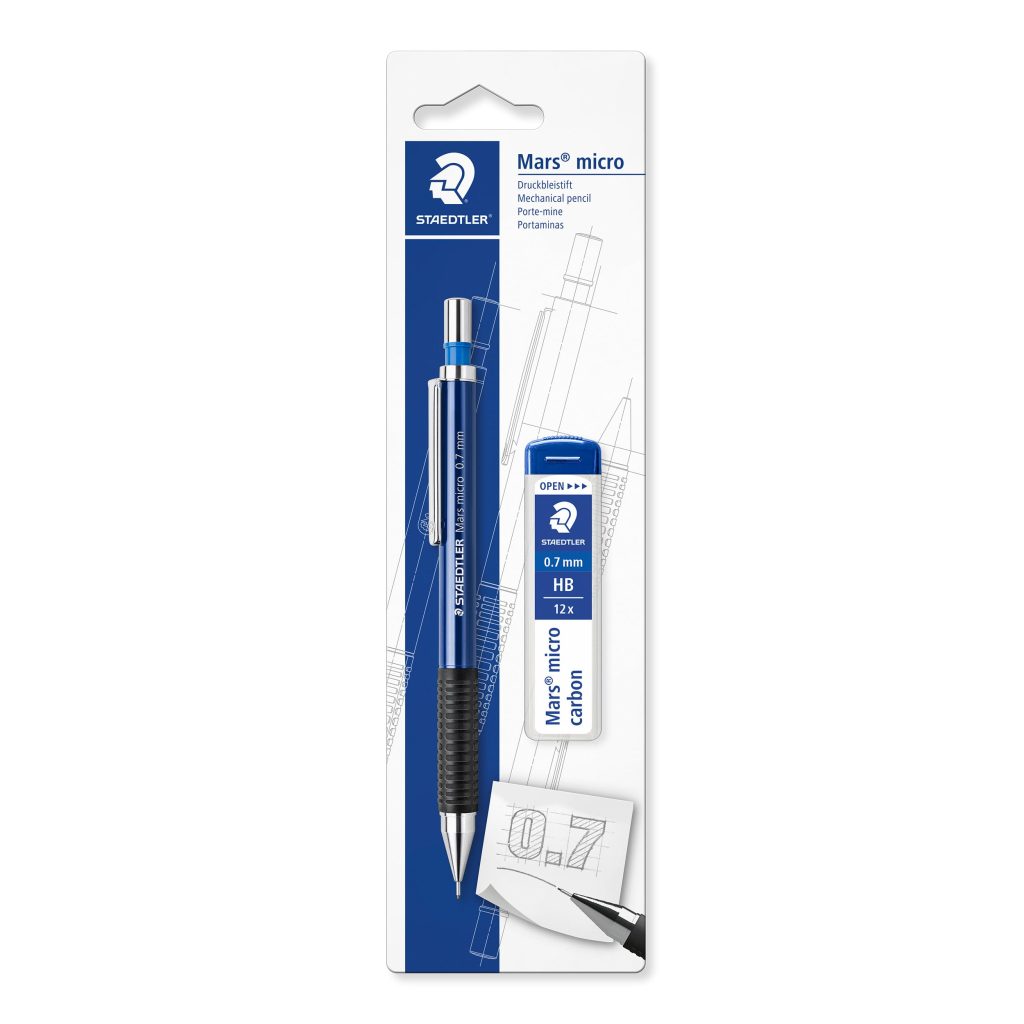
The STAEDTLER Mars Micro 7757 is a fairly unglamorous object. It is a 0.7mm mechanical pencil sold on a blister card with twelve spare lead refills included, and it sits in the part of the stationery market where function matters more than appearance. That framing is useful, because the pencil should be judged on how it behaves during ordinary writing and drafting rather than on how it looks on a pegboard.
The 0.7mm lead size is the first thing worth discussing, since it shapes most of the experience. It sits between the finer 0.5mm leads favoured for detailed technical drawing and the thicker 0.9mm leads that suit heavy-handed writers. In practice, 0.7mm is a sensible middle ground: dark enough to read clearly, thick enough to resist snapping under moderate pressure, and fine enough for notes, diagrams and form-filling. Anyone who writes quickly or presses hard will notice the difference immediately compared with a 0.5mm pencil, which tends to feel more fragile in the same hand.
The Mars Micro line is built around a few functional details that matter day to day. The lead advances via a push-button at the top, and the pencil includes a small eraser under a removable cap, which is standard for this category but still worth noting because the eraser is small and will wear down with regular use. The lead refills in the pack are a practical inclusion; twelve spare leads mean the pencil is usable for a long stretch before a replacement tube is needed, which is more than can be said for many pencils sold bare.
Where the pencil earns its place is in repetitive, low-drama tasks. It is the kind of tool that ends up in a pencil case for schoolwork, on a desk for jotting measurements, or in a bag for crossword puzzles and shopping lists. The 0.7mm line is legible on most paper stocks, and the mechanical advance means there is no sharpening, no wood shavings and no gradual blunting of the point. For anyone who has dealt with a wooden pencil going blunt halfway through a page of notes, that consistency is the main argument for a mechanical pencil in the first place.
It is not, however, a precision instrument. The barrel is lightweight plastic, and while that keeps the pencil comfortable for long writing sessions, it does not convey the solidity of a metal-bodied drafting pencil. The clip is functional but not especially robust, and the overall construction is clearly aimed at general use rather than professional drafting. Buyers expecting the heft and balance of a dedicated technical pencil may find it insubstantial. The eraser, too, is a compromise: it works for small corrections but smudges on larger areas and runs out relatively quickly.
Comparing it to alternatives helps set expectations. A wooden pencil remains cheaper per unit and offers a wider range of line variation as the point wears, which some sketchers prefer. A 0.5mm mechanical pencil gives a finer line for detailed work but demands a lighter touch. A 0.9mm pencil is more forgiving for children and heavy writers but can feel clumsy for small handwriting. The 0.7mm Mars Micro lands in the middle of that spectrum, which is both its strength and its limitation: it does most things adequately without excelling at any single one.
The included lead refills also raise a practical point. Refills are widely available and inexpensive, so the pencil is not locked into a proprietary system, but the small leads are easy to lose and the pack does not include a lead-loading tool beyond the pencil itself. Users who write heavily will go through the supplied leads faster than they might expect, particularly if they favour soft grades.
Who is this for? It suits students, office workers, and casual users who want a dependable pencil for notes, lists and light drawing, and who value the convenience of refills in the box. It is also a reasonable choice for anyone transitioning from wooden pencils who wants to avoid sharpening. Who is it not for? Serious drafters and illustrators who need a metal body, a retractable sleeve or a finer lead will likely outgrow it. Children who press very hard may still snap 0.7mm leads, and anyone wanting a premium feel should look at metal-bodied options instead.
Overall, the Mars Micro 7757 is a competent, ordinary pencil that does what it claims without fuss. It is not a tool that invites enthusiasm, but it is one that quietly gets used, which is arguably the better outcome for a pencil at this price and purpose.