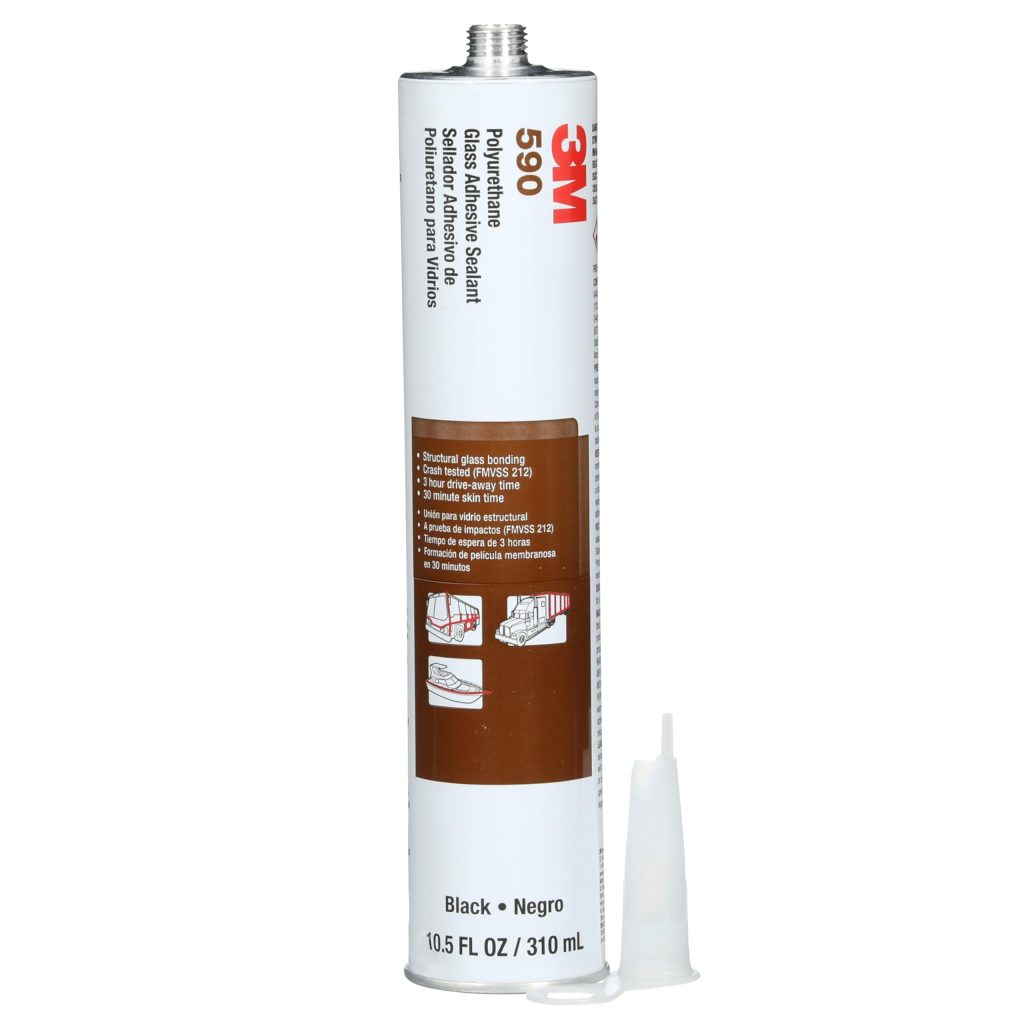
3M’s 590 is a single-component polyurethane adhesive sealant sold in a 310 mL cartridge, and it sits in a fairly specific corner of the market: jobs where glass or other substrates need a bond that also tolerates movement, weather, and time. It is not a general-purpose caulk, and treating it like one tends to lead to disappointment. Understanding what it actually is makes the product’s strengths and its quirks easier to place.
The most common real-world context is automotive glass and structural glazing. Body shops and glass installers use it to set windshields and bonded windows, where the bead has to cure into something closer to rubber than to brittle adhesive. It also shows up in architectural work—setting glass into metal frames, sealing panel joints, and bonding dissimilar materials where a rigid adhesive would crack under thermal cycling. In those settings the black color is not cosmetic; it hides the bead line and matches common gasket and trim colors. The cartridge format suits a standard caulking gun, which keeps application simple for one-off jobs but becomes a bottleneck on high-volume production lines compared with bulk or two-part systems.
Functionally, 590 is a moisture-curing polyurethane. It reacts with ambient humidity rather than needing a separate hardener, which is convenient but also means cure time depends on temperature and relative humidity. In warm, humid conditions a skin forms fairly quickly and full cure follows over a day or more, depending on bead thickness. In cold, dry shops the same bead can stay soft much longer, and that is worth planning around rather than discovering mid-job. The cured material is elastomeric—it stretches and recovers rather than shattering—and it adheres well to glass, many metals, and painted surfaces without a primer in typical applications, though surface prep still matters. It is also formulated to be non-conductive and is often cited in applications near electrical components, which is one reason it appears in automotive contexts beyond just glass.
Where the product earns its place is in the combination of bond strength and flexibility. A bead that holds glass to a frame while absorbing vibration and thermal expansion is doing two jobs at once, and polyurethane handles that better than silicone in many structural bonds and better than rigid epoxies in anything that moves. It also tolerates paint over the cured bead in some workflows, which silicones famously do not—silicone contamination causes fisheyes in paint, and that difference alone pushes many body shops toward polyurethane.
The trade-offs are real, though. Moisture-cure polyurethane is messier to work with than a water-based or silicone sealant. It skins over, it strings, and once it touches skin or clothing it is difficult to remove; gloves are not optional. Tooling the bead has a narrow window before skinning begins. Cure speed is variable, as noted, and the 310 mL cartridge yields a limited bead length—enough for a windshield or a handful of window units, but not for a large glazing project without multiple cartridges. Storage matters too: an opened cartridge does not keep indefinitely, and a cartridge past its shelf life may cure unevenly or not at all. There is also the matter of strength being a double-edged property—if a bonded assembly ever needs disassembly, polyurethane does not let go easily, and removal typically means cutting and mechanical work rather than solvent.
Compared with a conventional silicone sealant, 590 is the stronger structural bond and the better choice under paint, but silicone remains easier to tool, more forgiving of poor prep, and better for pure weathersealing where no structural load exists. Compared with a two-part polyurethane adhesive, the single-component cartridge is far simpler for small jobs but slower to reach full strength and less consistent in cure across varying conditions. Neither comparison makes 590 worse; it just narrows the cases where it is the right pick.
This product suits people doing automotive glass replacement, bonded window and panel work, and structural sealing where flexibility and adhesion both matter. It is a poor fit for someone who wants a quick cosmetic caulk line around a bathtub, for large-volume production where bulk dispensing makes more sense, or for anyone unwilling to wear gloves and manage cure conditions. Buyers should also check the date code on the cartridge, since freshness affects how predictably it cures. Used within its limits, 590 does a demanding job competently; used outside them, it will feel fussy and expensive.